For decades, control assurance has been dominated by effectiveness testing. Organizations assess whether controls worked as intended over a past period, typically aligned with the annual external audit cycle. This backward-looking approach made sense in a world where assurance was periodic, manual, and audit-driven.
But the way organizations manage risk has evolved. Digital processes, regulatory expectations, and management accountability increasingly demand forward-looking assurance, not just retrospective validation.
To understand this shift, let’s first revisit the full lifecycle of a control.
The Control Lifecycle: Four Interconnected Phases
When examined holistically, control assurance consists of four distinct, but interdependent phases:
- Design & Implementation
- Control Execution
- Effectiveness Testing
- Audit & Assurance

Each phase answers a different assurance question. Together, they determine whether controls genuinely support risk management rather than merely satisfy audit requirements.
Design& Implementation: The Foundation of Any Control
The first phase focuses on design and implementation. This phase assesses whether a control is capable of mitigating its associated risk and whether it has been properly embedded in the organization.
Two dimensions are assessed separately:
- Design – Is the control logically structured to mitigate the identified risk?
- Implementation – Is the control formally documented, communicated, and put into operation?
This phase is most commonly applied when establishing or updating a control framework. Responsible managers or employees are asked to provide evidence that controls have been implemented as intended. Once successfully assessed, a control can be classified as “implemented.”
From a governance perspective, this phase is non-negotiable: A control that is poorly designed or not implemented can not be meaningfully executed or tested for effectiveness.
A well-executed design and implementation assessment typically answers questions such as:
- Does the control still mitigate the linked risk?
- Is the control described as it is actually performed in practice?
- Does the description meet the standards of a good control definition (the 5 W’s and H)
Typical evidence includes:
- Policy and procedure documentation
- System configurations
- Proof of implementation
- Communication and training materials
Only once this foundation is in place does control execution become meaningful.
Control Execution: Where Assurance Moves into the Business
Control execution refers to the actual performance of a control, by people, systems, or a combination of both, according to its defined frequency and procedure.
Historically, controls were executed, but execution evidence was fragmented. Documentation was scattered across emails, shared drives, local folders, or not retained at all. As a result, management had limited visibility, and assuranceactivities remained labor-intensive.
Today, control execution is increasingly recognized as a first-line responsibility. Managers are accountable not only for risks, but also for ensuring that controls are executed consistently and transparently.
Controls may be:
- Manual
- Semi-automated
- Fully automated
Each brings its own challenges. Decentralized evidence storage makes oversight difficult, particularly for second-line functions assessing operating effectiveness.
A clear best practice has emerged: Centralize control execution and evidence.
Doing so simplifies work for control owners, improves transparency for management, and enables earlier detection of issues, allowing organizations to address weaknesses before they escalate.
Watch the webinar ISO 27001 Control Automation: From Control Execution to Continuous Assurance
Automated Controls: Opportunity Comes with Preconditions
Automated controls, such as IT General Controls (e.g. access management, change management) or application controls(e.g. enforced workflows, mandatory fields), offer significant potential for continuous assurance.
However, automation alone does not guarantee reliable evidence.
In practice, organizations often encounter barriers such as:
- Limited data availability – Control data cannot be easily extracted from source systems
- Data quality issues – Incomplete or inconsistent data undermines reliability
- Insufficient logging and monitoring – Common in legacy environments
- Weak control descriptions – Lack of standardization creates misalignment between expected and actual evidence
Without addressing these prerequisites, continuous control monitoring remains aspirational rather than achievable.
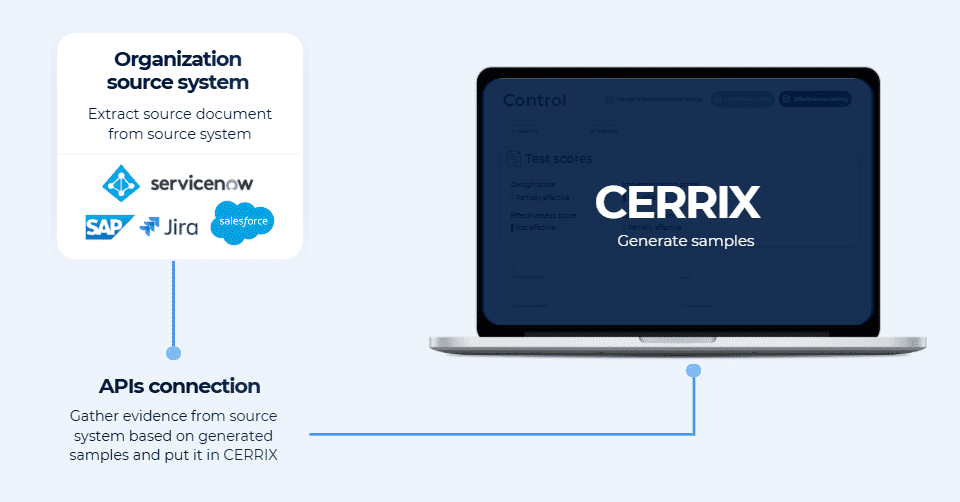
To support this, CERRIX introduced Execution-Based Control Testing. Automated controls can expose their execution results via the Control Execution API, allowing near-real-time capture of execution data directly from source systems. These execution records are then reused for effectiveness testing through automated sampling and review workflows, without relying on screenshots or manually prepared population files.
By linking automated executions directly to effectiveness testing, CERRIX enables continuous insight into control operation while preserving audit trails and expert judgement. Automation therefore strengthens assurance reliability rather than merely accelerating testing activities.
Effectiveness Testing: Still Relevant, but No Longer Sufficient
Effectiveness testing remains the most familiar phase of control assurance. Traditionally, assurance programs relied heavily on periodic tests that looked back over a defined period, mirroring the approach of internal and external audits.
Effectiveness testing answers a critical question: Did the control actually work?
But this assessment is only meaningful if:
- Control execution is properly documented
- Evidence is reliable, complete, and traceable
Modern approaches increasingly support automated effectiveness testing, including:
- Sampling based on execution data
- Direct links to source systems
- Reduced reliance on manual evidence collection
-
This shifts effectiveness testing from a standalone exercise to a natural outcome of structured execution and monitoring.
Audit & Assurance
Audit &assurance form the final phase of the control lifecycle and provide independent validation that controls are designed, executed, and operating effectively. This role is typically fulfilled by internal audit, external auditors, or supervisors.
Historically, audit has driven control testing by looking back at a defined period. In a mature control assurance model, this dynamic changes: audit becomes a user of assurance outputs, not the driver of control execution or testing.
When control design, execution, and effectiveness testing are properly embedded and documented, audit can rely on existing evidence. This enables a shift from ad-hoc audit preparation to continuous audit readiness, reduces disruption to the business, and allows audit to focus on judgement, challenge, and improvement rather than reconstruction of evidence.
Audit & assurance therefore act as the closing loop in the control lifecycle, confirming that the organization is not only compliant, but demonstrably in control.
Conclusion: From Control Activities to Continuous Monitoring
Effective control assurance is not about performing more tests, it is about creating confidence through clarity, ownership, and quality.
- Design & Implementation provide the foundation: clean, reliable control frameworks that are clearly defined, consistently applied, and aligned with the risks they are meant to mitigate. Without this hygiene factor, assurance lacks credibility.
- Control Execution brings assurance into the business. By making execution transparent and structured, managers gain direct insight into how controls operate in practice. Control assurance becomes a management instrument, not an audit exercise.
- Effectiveness Testing adds professional judgement. Through expert review of execution data and evidence, organizations gain a cohesive and complete view of control performance, focused on quality, not volume.
Together, these values shift control assurance from a retrospective compliance activity to make it audit readiness day by day, one that supports informed decision-making, strengthens accountability, and builds lasting trust with internal and external stakeholders.
Blog author
Ruben Andeweg (Senior Risk Consultant, CERRIX)
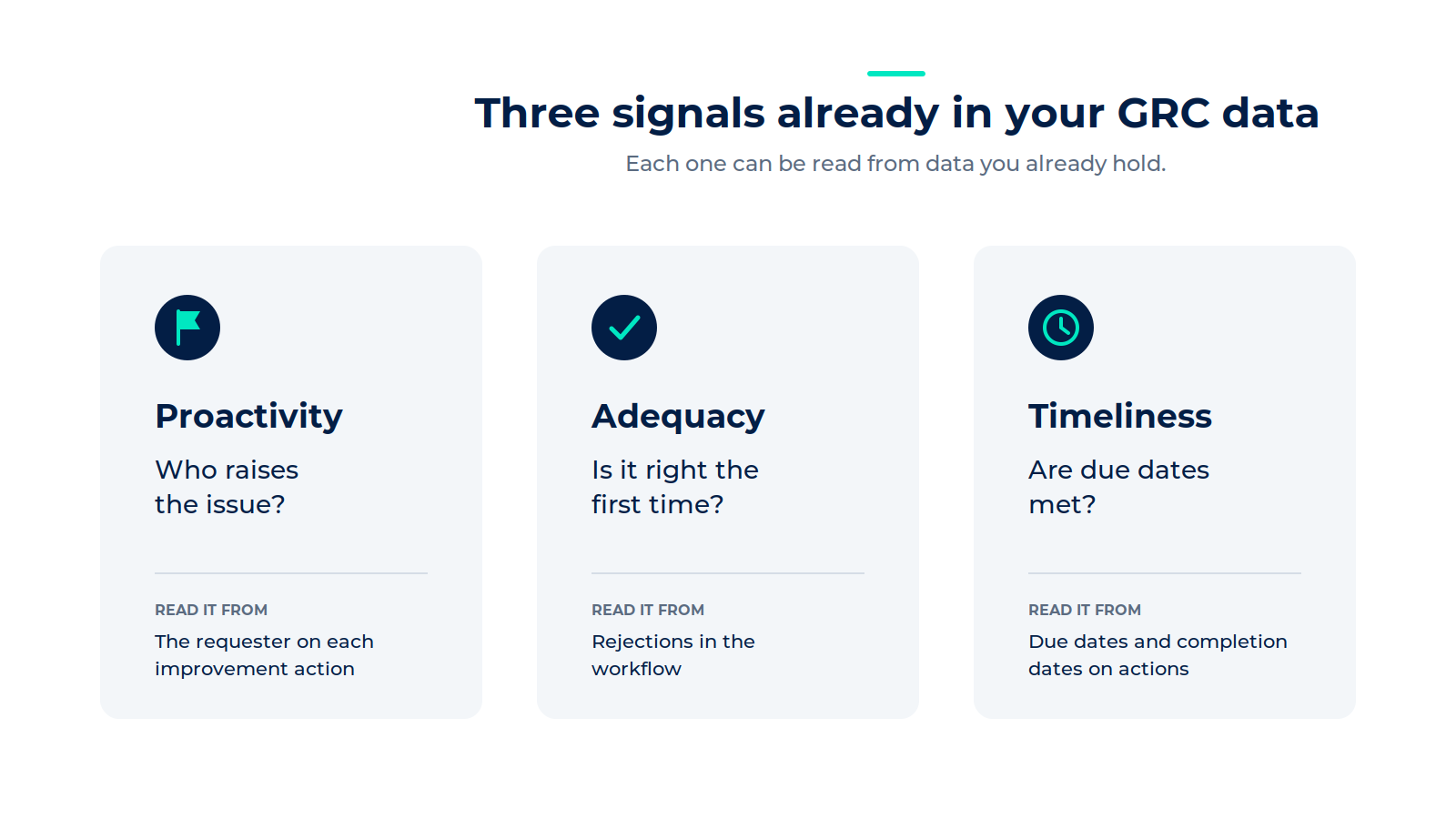
Three signals in your GRC data that show how your organisation handles risk
Takeaways from the CERRIX webinar with Jeroen Tacke and Ruben Andeweg: three signals in your GRC data that show how your organisation handles risk.
.png)
CERRIX vs Diligent: GRC software compared across features, European market fit and compliance
A side-by-side look at two GRC platforms, and which one fits the DORA, NIS2, and ISQM obligations European teams carry.
.png)
Conversational GRC: work with your risk data from the AI agent you already use
Query your controls, update tasks, and generate board-ready reports, all from Claude, Microsoft Copilot or another AI agent.
.jpg)
CERRIX vs ServiceNow: GRC software compared across features, pricing, and compliance
CERRIX vs ServiceNow: GRC Software compared across features, pricing, and compliance (2026)
.jpg)
AI in GRC: beyond the hype. What actually works at every level of adoption
Key takeaways from the CERRIX panel on AI in GRC, with practitioners from CERRIX, AuditAgent and 8weeks.co sharing what actually works.
.avif)
Top European GRC tools in 2026: An insider's comparison
This blog compares the top GRC platforms available to European organizations in 2026

What Does GRC Look Like in 2030?
By 2030, AI in GRC will automate evidence collection, control monitoring, and routine reporting across all three lines of defense, shifting risk managers from administrative work to strategic advisory roles

The Complete GRC Chain: Connecting Regulatory Change Management, Risk, and Controls in One Platform
The future of Governance, Risk & Compliance (GRC) lies in connecting regulatory change management directly to risks, controls, incidents, actions, and assurance activities in one integrated platform.

Embedding automation into your risk operating model: Where AI fits and how to make It work
This second part focuses on what makes that automated model intelligent. Where AI fits. What it means for risk professionals in practice.

From checkbox to continuous: How to embed automation into your risk operating model
What it means to truly embed automation into the risk operating model: what changes, what stays the same, and what it takes to make it work in practice.
.jpg)
Why CERRIX acquired Ruler, and what it means for the future of GRC
CERRIX acquires Ruler to connect regulatory change with risk management.
%20(1).png)
Why Data Quality Is the Foundation of AI and Automation in GRC
A strategic look at why structured data in a GRC tool is imperative for automation, AI enabled workflows, and real time risk insights.
.jpg)
Internal Control Framework Challenges: Why COSO and ISO 31000 Implementations Struggle in Practice
Why do internal control framework implementations (COSO, ISO 31000) struggle? Explore common challenges in process design, ownership, tooling, and governance
%20(3).jpg)
Control Assurance Explained: How Organizations Move from Control Testing to Continuous Monitoring
Discover how modern control assurance moves beyond periodic testing to continuous monitoring, with clear ownership, automation, and expert opinion.

Incident Management under DORA: What Risk and Compliance Leaders Need to Rethink
Incident Management under DORA: What Risk and Compliance Leaders Need to Rethink
.jpg)
Hoe u ISO 31000 Risicobehandeling in de Praktijk Toepast: Inzichten voor Risk- en Complianceleiders
A practical recap of CERRIX ISO 31000 risk treatment webinar
%20(1).jpg)
Hoe Wij CERRIX GRC Gebruiken voor het Beheren van Ons ISMS. ISO 27001 in de Praktijk
Wij gebruiken onze eigen CERRIX GRC-software om het ISMS van CERRIX te beheren. Zo maken we van compliance een continu proces en laten we zien hoe ISO 27001 onderdeel wordt van de dagelijkse praktijk.
%20(1).jpg)
Hoe bereken je risicokans en -impact?
Leer hoe je risicokans en -impact berekent volgens ISO 31000. Ontdek hoe gestructureerde risicobeoordeling, scoringsmodellen en risicomatrices bijdragen aan effectief risicomanagement met CERRIX.
.jpg)
Why the Three Lines of Defense Model Is Outdated? What Every Board Should Know About the Three Lines Model
Three Lines Model Explained: Why Boards Must Move Beyond 3LOD
.jpg)
What Is ISO 31000 and How Does It Work?
Discover what ISO 31000 is, how it works, and why it’s essential for risk management in 2025. Learn the principles, framework, and how tools like CERRIX help organizations turn ISO 31000 into practice.
.jpg)
How to Write an Incident Report That Stands Up to Audits
Learn how to write incident reports that are clear, evidence-backed, and audit-ready. Includes a template, best practices, and compliance alignment for risk professionals.
.jpg)
How to Implement ISO 31000: Real-Time Risk Decisions with AI‑Enabled Tools
Discover how to move beyond compliance and operationalize ISO 31000 using AI, real-time dashboards, and structured risk assessments. Learn from webinar insights and best practices tailored for financial services and regulated industries.
%20(1).jpg)
What’s Blocking Your ISMS Rollout? 7 Fixable Challenges for Financial Institutions
Discover the 7 biggest blockers in ISMS rollout for financial institutions—and how to solve them. Learn practical strategies to secure buy-in, define scope, streamline controls, and prepare for ISO 27001 certification.
.jpg)
Trends Driving ISMS Adoption in 2025: What Risk & Compliance Leaders Need to Know
Discover the top trends pushing organizations toward ISMS adoption in 2025—from regulatory changes and remote work to threat evolution and AI. Learn what to prioritize to stay ahead in risk and compliance.
What Is an ISMS? A Practical Guide for Risk & Compliance Leaders in 2025
An Information Security Management System (ISMS) is more than policy—it’s your organization’s shield against evolving threats, regulation, and reputation risk. Discover what ISMS means, how to implement it, and why it matters in 2025.
.jpg)
The Intelligent Future of GRC: How AI is Reshaping Governance, Risk & Compliance in 2025
Explore how AI is transforming GRC in 2025—from predictive insights and automation to ethical oversight. Learn what features matter, what risks to manage.
.jpg)
How Do You Implement an ISMS in Financial Services Without Slowing Down Innovation?
Implementing an ISMS in financial services? Explore a practical, risk-aligned roadmap tailored for banks, fintechs, and insurers to meet ISO 27001, GDPR, and DORA compliance—without compromising agility.

How Do You Build a Robust ISMS Framework Based on ISO 27001?
Learn how to build a robust ISMS framework aligned with ISO 27001. Discover the key components—people, policies, processes, and controls—to strengthen security and achieve compliance.
.jpg)
When to Conduct Risk Assessments: 6 Enterprise-Critical Moments
Learn when to conduct risk assessments—annual, quarterly, after incidents or change—and how CERRIX ensures continuous compliance.
.jpg)
How do you build a system of quality management that works under ISQM 1?
Learn how to build a system of quality management under ISQM 1. Move beyond compliance to an operational model that proves audit quality.

What Are Risk Scoring Methods for Financial Institutions? [2025 Guide]

From Risk Assessment to Risk Management: Moving Beyond Checklists in 2025
Understand the evolution from risk assessment to strategic risk management in 2025. Learn why leading organizations are embedding risk into decision-making—and how GRC platforms like CERRIX support this shift.
What is risk management? A strategic guide for leaders in 2025

How Audit Firms Embed ISQM into Daily Practice
In our second ISQM webinar, experts from RSM, Grant Thornton, and CERRIX shared practical insights on how audit firms can embed ISQM into the heart of their operations.

Embedding ISQM 1 into the DNA of Your Audit Firm: A Risk-Based Approach to Quality Management
Discover how to implement ISQM 1 with a risk-based approach. Learn how audit firms can embed quality management into daily operations and governance.
%20(1).avif)
CERRIX User Conference 2025
Op 12 maart 2025 kwamen marktleiders, verzekeringsexperts en CERRIX-klanten samen voor de CERRIX User Conference 2025, een dag van kennisuitwisseling, inzichtelijke discussies en samenwerking over de toekomst van risicobeheer, compliance en AI-gestuurde GRC-oplossingen.

Van spreadsheets tot GRC-software: waarom pensioenfondsen een moderne benadering van risicobeheer nodig hebben

CERRIX en BR1GHT versterken langdurige samenwerking om oplossingen voor bestuur, risico, compliance en audit te verbeteren

DORA implementeren: van compliance tot veerkracht op lange termijn
