
In today’s rapidly changing risk landscape, organizations increasingly recognize that traditional governance. Risk and compliance frameworks built on spreadsheets, periodic reviews, and manual processes are no longer sufficient. Emerging technology trends show that automation and artificial intelligence are reshaping risk management practices by enabling real time monitoring, predictive insights, and smarter decision making. However, these advancements depend on one core prerequisite: high quality structured data.
The problem with manual GRC models
Many GRC programs remain rooted in manual risk and control processes. In this environment:
• Risks are logged by individuals in different formats
• Control documentation varies across teams
• Evidence is stored in disconnected systems
• Incidents are recorded after impact
• Dashboards summarize static snapshots
This fragmentation undermines the ability to derive consistent, actionable intelligence. It also creates what many industry leaders describe as a false sense of control. Reports may look complete, but the underlying data is inconsistent and unreliable.
Even well designed risk registers and control libraries can fail when data quality is weak. Without structure and consistency in risk descriptions, automated processes cannot correctly interpret context, link related entities, or enable dynamic responses.
Why data matters before automation
Experts increasingly highlight that good data is not just a technical concern. It is a governance foundation. Modern risk management thinking emphasizes that transitioning to proactive and continuous compliance requires both structured data and integrated platforms that can analyze it.
As Joachim Jonkers, Chief Product Officer at CERRIX, explains:
“AI can help risk teams move faster and surface better insights, but it cannot compensate for unclear or inconsistent data. If your risks and controls are not structured properly, automation will only accelerate the confusion. Intelligent GRC starts with structured, reliable risk data.”
High quality risk and control data enables:
• Consistent risk scoring across lines of business and units
• Reliable trend analysis where pattern detection becomes meaningful
• Traceable evidence and audit trails that support defensible reporting
• AI assisted insights that rely on structured and complete inputs
Without structured data, automation and AI simply amplify inconsistency and uncertainty. Automation can accelerate tasks, but it cannot create clarity where none exists.
The consequences of poor data quality
Inadequate data creates both operational and governance risk:
• Control fatigue as teams spend time reconciling gaps instead of analyzing impact
• Audit bottlenecks due to repeated clarification cycles
• Delayed risk updates where emerging issues surface only after failure
• Inconsistent evidence that masks evolving exposure
Organizations that rely on manual or partially structured processes often struggle to move from reactive reporting to intelligent risk insight. The gap is not always technology. It is structural consistency.
What good GRC data looks like
High quality GRC data shares several characteristics:
• Standardized formats where risk descriptions follow consistent logic such as cause, event, and impact
• Linked constructs where risks, controls, incidents, and metrics are connected rather than siloed
• Structured evidence that is traceable and auditable
• Dynamic scoring that reflects contextual inputs rather than static review cycles
These characteristics align with established risk frameworks such as ISO 31000, which emphasize integration of risk management into decision making and organizational processes rather than isolated review exercises.
From manual processes to intelligent automation
Once risk and control data is structured, organizations can begin embedding automation into the risk operating model. This is where modern GRC platforms make a measurable difference.
GRC platforms such as CERRIX are designed to move organizations from manual documentation toward intelligent automation. CERRIX GRC platform ensures risks, controls, evidence, and remediation actions are structured and connected within a single environment.
Instead of teams manually interpreting and updating risk information across multiple tools, CERRIX GRC platforms can support this process through AI assisted workflows:
• Extract risks and controls from documentation or assessments to reduce manual entry
• Refine risk and control descriptions to ensure consistent structure and clarity
• Suggest potential risks, controls, or remediation actions based on existing data
• Link incidents, risks, controls, and remediation actions automatically
• Validate whether evidence is relevant and complete for a given control
• Generate structured testing plans and execution tasks for control owners
These capabilities reduce the administrative burden on risk teams while improving consistency across the framework.
Watch our webinar “ISO 27001 Control Automation”, where we explore how AI and automation can support risk teams in improving control testing, evidence collection, and overall GRC efficiency.
The strategic imperative
In a world where risk is dynamic, interdependent, and fast moving, traditional GRC frameworks are becoming increasingly difficult to sustain. Organizations that invest in high quality, structured risk data are better positioned to build defensible insights for boards and regulators, reduce the administrative burden on risk teams, enable continuous monitoring and early warning signals, connect risk functions across the enterprise, and move from compliance assurance toward strategic risk leadership.
The shift from manual GRC models to intelligent automation is therefore not purely technical. It is strategic. Data quality is the foundation upon which automation, AI assisted insights, and continuous compliance are built. Only with structured and reliable data can organizations automate routine tasks, surface meaningful insights, and strengthen governance without increasing headcount or control fatigue.
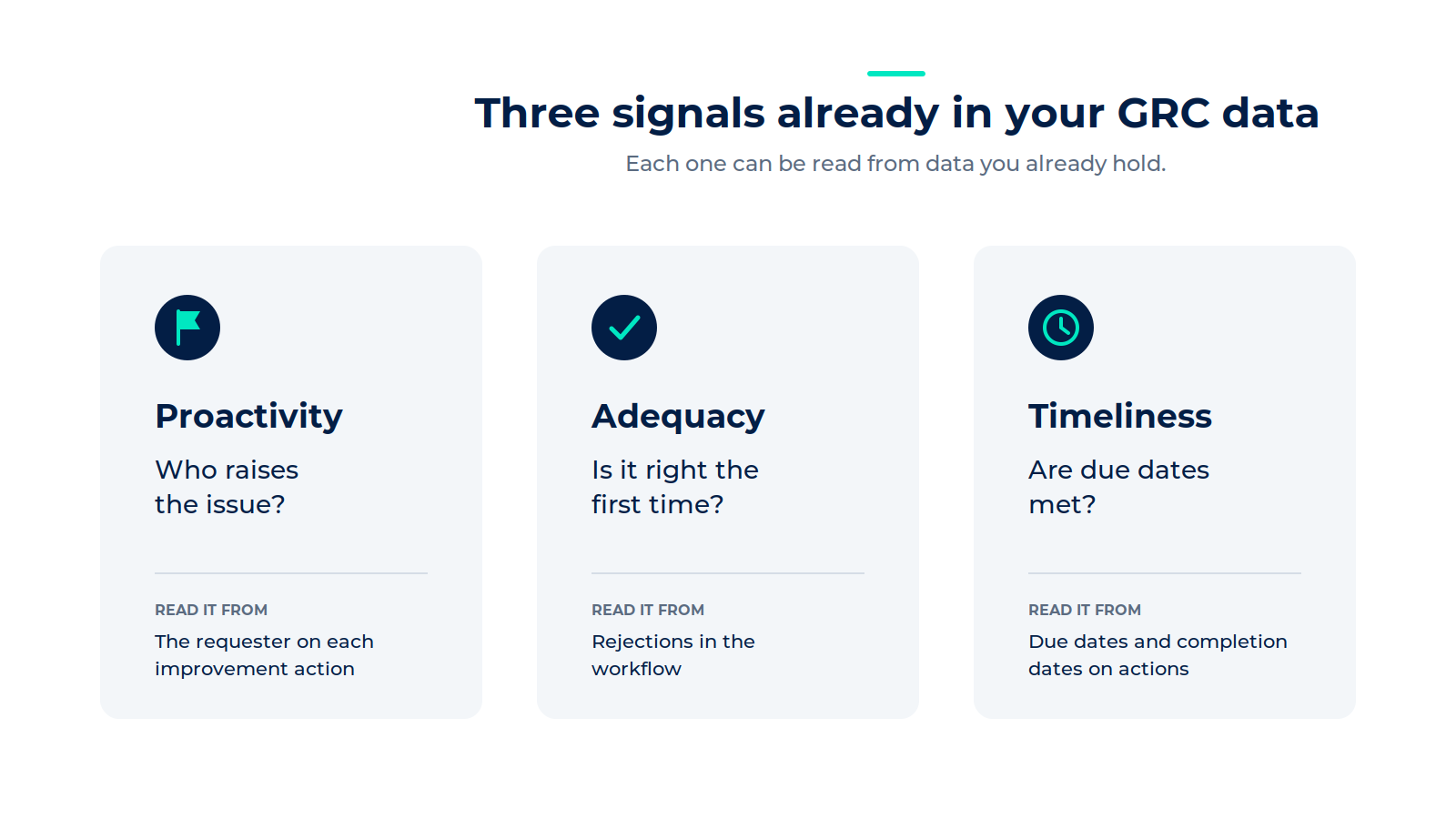
Three signals in your GRC data that show how your organisation handles risk
Takeaways from the CERRIX webinar with Jeroen Tacke and Ruben Andeweg: three signals in your GRC data that show how your organisation handles risk.
.png)
CERRIX vs Diligent: GRC software compared across features, European market fit and compliance
A side-by-side look at two GRC platforms, and which one fits the DORA, NIS2, and ISQM obligations European teams carry.
.png)
Conversational GRC: work with your risk data from the AI agent you already use
Query your controls, update tasks, and generate board-ready reports, all from Claude, Microsoft Copilot or another AI agent.
.jpg)
CERRIX vs ServiceNow: GRC software compared across features, pricing, and compliance
CERRIX vs ServiceNow: GRC Software compared across features, pricing, and compliance (2026)
.jpg)
AI in GRC: beyond the hype. What actually works at every level of adoption
Key takeaways from the CERRIX panel on AI in GRC, with practitioners from CERRIX, AuditAgent and 8weeks.co sharing what actually works.
.avif)
Top European GRC tools in 2026: An insider's comparison
This blog compares the top GRC platforms available to European organizations in 2026

What Does GRC Look Like in 2030?
By 2030, AI in GRC will automate evidence collection, control monitoring, and routine reporting across all three lines of defense, shifting risk managers from administrative work to strategic advisory roles

The Complete GRC Chain: Connecting Regulatory Change Management, Risk, and Controls in One Platform
The future of Governance, Risk & Compliance (GRC) lies in connecting regulatory change management directly to risks, controls, incidents, actions, and assurance activities in one integrated platform.

Embedding automation into your risk operating model: Where AI fits and how to make It work
This second part focuses on what makes that automated model intelligent. Where AI fits. What it means for risk professionals in practice.

From checkbox to continuous: How to embed automation into your risk operating model
What it means to truly embed automation into the risk operating model: what changes, what stays the same, and what it takes to make it work in practice.
.jpg)
Why CERRIX acquired Ruler, and what it means for the future of GRC
CERRIX acquires Ruler to connect regulatory change with risk management.
%20(1).png)
Why Data Quality Is the Foundation of AI and Automation in GRC
A strategic look at why structured data in a GRC tool is imperative for automation, AI enabled workflows, and real time risk insights.
.jpg)
Internal Control Framework Challenges: Why COSO and ISO 31000 Implementations Struggle in Practice
Why do internal control framework implementations (COSO, ISO 31000) struggle? Explore common challenges in process design, ownership, tooling, and governance
%20(3).jpg)
Control Assurance Explained: How Organizations Move from Control Testing to Continuous Monitoring
Discover how modern control assurance moves beyond periodic testing to continuous monitoring, with clear ownership, automation, and expert opinion.

Incident Management under DORA: What Risk and Compliance Leaders Need to Rethink
Incident Management under DORA: What Risk and Compliance Leaders Need to Rethink
.jpg)
Hoe u ISO 31000 Risicobehandeling in de Praktijk Toepast: Inzichten voor Risk- en Complianceleiders
A practical recap of CERRIX ISO 31000 risk treatment webinar
%20(1).jpg)
Hoe Wij CERRIX GRC Gebruiken voor het Beheren van Ons ISMS. ISO 27001 in de Praktijk
Wij gebruiken onze eigen CERRIX GRC-software om het ISMS van CERRIX te beheren. Zo maken we van compliance een continu proces en laten we zien hoe ISO 27001 onderdeel wordt van de dagelijkse praktijk.
%20(1).jpg)
Hoe bereken je risicokans en -impact?
Leer hoe je risicokans en -impact berekent volgens ISO 31000. Ontdek hoe gestructureerde risicobeoordeling, scoringsmodellen en risicomatrices bijdragen aan effectief risicomanagement met CERRIX.
.jpg)
Why the Three Lines of Defense Model Is Outdated? What Every Board Should Know About the Three Lines Model
Three Lines Model Explained: Why Boards Must Move Beyond 3LOD
.jpg)
What Is ISO 31000 and How Does It Work?
Discover what ISO 31000 is, how it works, and why it’s essential for risk management in 2025. Learn the principles, framework, and how tools like CERRIX help organizations turn ISO 31000 into practice.
.jpg)
How to Write an Incident Report That Stands Up to Audits
Learn how to write incident reports that are clear, evidence-backed, and audit-ready. Includes a template, best practices, and compliance alignment for risk professionals.
.jpg)
How to Implement ISO 31000: Real-Time Risk Decisions with AI‑Enabled Tools
Discover how to move beyond compliance and operationalize ISO 31000 using AI, real-time dashboards, and structured risk assessments. Learn from webinar insights and best practices tailored for financial services and regulated industries.
%20(1).jpg)
What’s Blocking Your ISMS Rollout? 7 Fixable Challenges for Financial Institutions
Discover the 7 biggest blockers in ISMS rollout for financial institutions—and how to solve them. Learn practical strategies to secure buy-in, define scope, streamline controls, and prepare for ISO 27001 certification.
.jpg)
Trends Driving ISMS Adoption in 2025: What Risk & Compliance Leaders Need to Know
Discover the top trends pushing organizations toward ISMS adoption in 2025—from regulatory changes and remote work to threat evolution and AI. Learn what to prioritize to stay ahead in risk and compliance.
What Is an ISMS? A Practical Guide for Risk & Compliance Leaders in 2025
An Information Security Management System (ISMS) is more than policy—it’s your organization’s shield against evolving threats, regulation, and reputation risk. Discover what ISMS means, how to implement it, and why it matters in 2025.
.jpg)
The Intelligent Future of GRC: How AI is Reshaping Governance, Risk & Compliance in 2025
Explore how AI is transforming GRC in 2025—from predictive insights and automation to ethical oversight. Learn what features matter, what risks to manage.
.jpg)
How Do You Implement an ISMS in Financial Services Without Slowing Down Innovation?
Implementing an ISMS in financial services? Explore a practical, risk-aligned roadmap tailored for banks, fintechs, and insurers to meet ISO 27001, GDPR, and DORA compliance—without compromising agility.

How Do You Build a Robust ISMS Framework Based on ISO 27001?
Learn how to build a robust ISMS framework aligned with ISO 27001. Discover the key components—people, policies, processes, and controls—to strengthen security and achieve compliance.
.jpg)
When to Conduct Risk Assessments: 6 Enterprise-Critical Moments
Learn when to conduct risk assessments—annual, quarterly, after incidents or change—and how CERRIX ensures continuous compliance.
.jpg)
How do you build a system of quality management that works under ISQM 1?
Learn how to build a system of quality management under ISQM 1. Move beyond compliance to an operational model that proves audit quality.

What Are Risk Scoring Methods for Financial Institutions? [2025 Guide]

From Risk Assessment to Risk Management: Moving Beyond Checklists in 2025
Understand the evolution from risk assessment to strategic risk management in 2025. Learn why leading organizations are embedding risk into decision-making—and how GRC platforms like CERRIX support this shift.
What is risk management? A strategic guide for leaders in 2025

How Audit Firms Embed ISQM into Daily Practice
In our second ISQM webinar, experts from RSM, Grant Thornton, and CERRIX shared practical insights on how audit firms can embed ISQM into the heart of their operations.

Embedding ISQM 1 into the DNA of Your Audit Firm: A Risk-Based Approach to Quality Management
Discover how to implement ISQM 1 with a risk-based approach. Learn how audit firms can embed quality management into daily operations and governance.
%20(1).avif)
CERRIX User Conference 2025
Op 12 maart 2025 kwamen marktleiders, verzekeringsexperts en CERRIX-klanten samen voor de CERRIX User Conference 2025, een dag van kennisuitwisseling, inzichtelijke discussies en samenwerking over de toekomst van risicobeheer, compliance en AI-gestuurde GRC-oplossingen.

Van spreadsheets tot GRC-software: waarom pensioenfondsen een moderne benadering van risicobeheer nodig hebben

CERRIX en BR1GHT versterken langdurige samenwerking om oplossingen voor bestuur, risico, compliance en audit te verbeteren

DORA implementeren: van compliance tot veerkracht op lange termijn
