
In part 1 of this blog, we explored what a risk operating model is, why the traditional model is no longer adequate for the pace of modern regulation, and what it means to truly embed automation, across continuous control monitoring, first-line ownership, workflow-driven escalation, and real-time reporting. We also looked at how automation changes the role of each line: business teams become genuine risk owners, the second line shifts from collecting data to challenging decisions, and internal audit moves from annual testing to continuous assurance.
This second part focuses on what makes that automated model intelligent. Where AI fits. What it means for risk professionals in practice. And how to approach the transformation in a way that actually sticks.
Where AI fits in the automated risk operating model
Automation sets the foundation. AI is what makes it adaptive - surfacing patterns, predicting risk concentrations, and flagging issues before they become findings.
There is a meaningful difference between a platform that automates workflows and one that learns from them. In a mature risk operating model, AI operates as the intelligence layer sitting above automated processes - making the system progressively smarter over time.
In practice, this means three things for risk teams:
1. AI processes what no team could manually review
Automated systems generate large volumes of control data, risk signals, and monitoring outputs. AI can process this at scale - identifying outliers, correlations, and emerging patterns across the entire control environment that would take weeks to surface through manual review. Risk teams stop looking for the signal in the noise and start working with the signal directly.
2. AI enables predictive risk management
Rather than reporting on what went wrong last quarter, risk functions can surface where pressure is building before it materialises into an incident or finding. AI-powered platforms analyse historical patterns, regulatory change velocity, and control performance trends to generate forward-looking indicators - shifting the risk function from reactive to genuinely anticipatory.
3. AI reduces cognitive load on risk professionals
Routine analysis, report drafting, and control scoring can be handled automatically - freeing risk professionals to focus on the decisions that require human judgment. The value of the risk function shifts from volume of activity to quality of insight.
CERRIX has integrated AI into its GRC platform to sharpen how organisations work with risk, from refining risk and control descriptions to extracting risks and controls from a document using AI (upcoming). The recent acquisition of Ruler extends this into the regulatory layer, automatically connecting new and changing requirements to the relevant risks, policies, and controls in the platform.
Learn more GRC in 2030: Why spreadsheets and periodic compliance won’t survive AI
Importantly, AI does not replace human judgment in risk management - it enhances it. The platform provides the signals; the risk professional provides the interpretation and the decision. That combination is what makes an automated, AI-enabled risk operating model genuinely more resilient than its manual predecessor.
The practical challenge: It is not just a technology question
Many organizations invest in GRC platforms without achieving the transformation they expected. The technology is rarely the limiting factor. The real challenges are organizational.
Several patterns tend to derail automation programmes:
- Automation is implemented on top of broken processes. If the underlying risk taxonomy, control framework, or ownership model is unclear, automation will simply make the confusion faster and more visible.
- The first line is not engaged. If business teams view the GRC platform as a compliance burden imposed by a central team, adoption fails. Embedding automation requires embedding a risk-ownership culture alongside it.
- Data quality is not addressed upfront. Automated systems depend on accurate, timely data. If data sources are siloed, inconsistent, or incomplete, automated outputs will be misleading.
- The second line does not change its model. If automation frees up capacity but the risk function continues operating as it always has - collecting data, producing reports - the investment delivers limited value.
The organizations that succeed treat automation as a change programme, not an implementation project. They redesign their operating model alongside the technology, invest in adoption, and measure success by risk outcomes - not by platform usage metrics.
Where to start: A practical approach
There is no universal sequence for embedding automation into a risk operating model. The right starting point depends on where the organization currently struggles most. That said, a few principles hold across contexts:
Start with the processes that cause the most friction
Look at where your teams spend disproportionate time on low-value activity: evidence collection, status chasing, report assembly, manual consolidation. These are the highest-ROI targets for early automation and will generate the organizational credibility needed to expand the programme.
Clarify ownership before automating workflows
Automation enforces accountability. Before automating a workflow, be explicit about who owns what - which risks, which controls, which escalation paths. If ownership is ambiguous, automation will surface the ambiguity immediately and create friction. Resolve it first.
Connect your risk data to operational systems
The most powerful automation integrations connect the GRC platform to the systems where work actually happens: HR systems for organizational change, incident management tools for operational events, IT systems for control evidence. When risk data flows automatically from operations, the monitoring layer becomes genuinely continuous.
Design for the first line
The user experience for business teams is often an afterthought in GRC implementations. It should be the primary design concern. If self-assessments are burdensome, attestations are confusing, or incident reporting is cumbersome, first-line engagement will collapse. Simplicity and role-based relevance are not cosmetic - they are essential to the model working at scale.
Measuring success: Beyond efficiency
The most common measure of GRC automation success is efficiency: time saved, reports produced faster, assessments completed on schedule. These matter, but they are not the right primary measure.
The more meaningful indicators of a successfully embedded automation model include:
- Risk issues are identified and escalated faster - the time between a threshold breach and a management response is measurably shorter.
- The first line participates more actively - self-assessment completion rates, incident reporting volumes, and attestation quality improve.
- Audit findings decrease over time - continuous monitoring catches issues before they become findings.
- Board reporting requires less effort to produce and is more trusted - because it reflects real-time data, not assembled snapshots.
- Regulatory readiness is continuous - organizations can respond to examiner requests with current evidence, not historical reconstruction.
These outcomes represent a genuine shift in organizational risk maturity - from compliance as a periodic exercise to risk management as an embedded capability.
Conclusion: The best risk operating model is to make risk management inseparable from how the business operates
The organizations that will manage risk most effectively in the coming years are not those with the largest risk teams or the most comprehensive policies. They are those that have made risk management inseparable from how the business operates - where controls are continuous, ownership is real, and insight is available in real time.
Embedding automation into the risk operating model is how that future gets built. AI is what makes that future intelligent. Together, they shift the risk function from a periodic compliance exercise to a continuous, adaptive capability - one that learns, anticipates, and improves over time.
It is not a single technology decision. It is a sustained commitment to redesigning how the organization identifies, monitors, and responds to risk - using automation and AI as the infrastructure that makes a better model possible at scale.
About CERRIX
CERRIX is a GRC platform designed to help regulated organizations embed risk management into the way they work. From continuous control monitoring and automated workflows to real-time dashboards and integrated compliance management, CERRIX supports the full risk operating model - across all three lines of defense.
Interested in how CERRIX supports risk automation? Get in touch with our team.
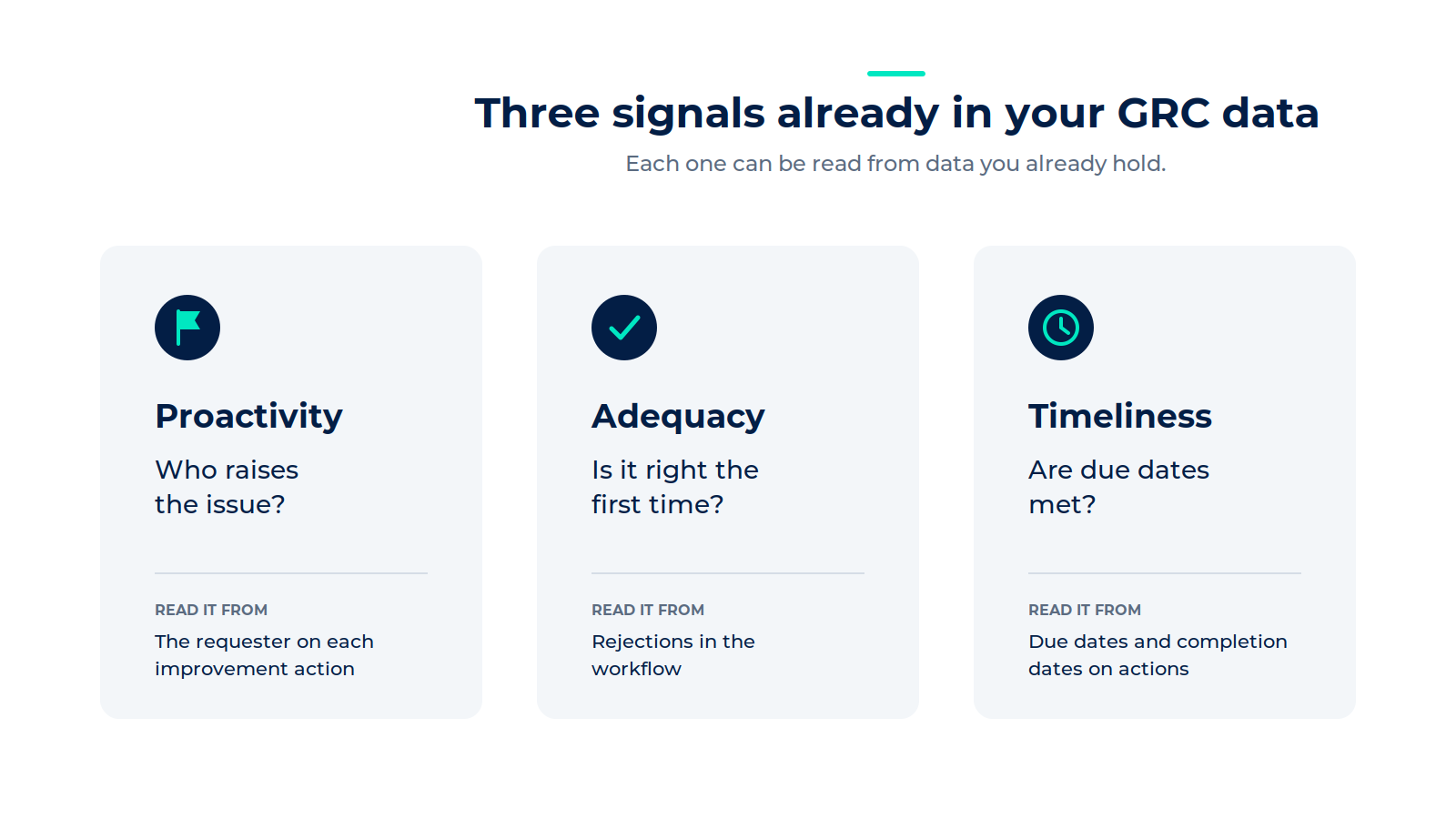
Three signals in your GRC data that show how your organisation handles risk
Takeaways from the CERRIX webinar with Jeroen Tacke and Ruben Andeweg: three signals in your GRC data that show how your organisation handles risk.
.png)
CERRIX vs Diligent: GRC software compared across features, European market fit and compliance
A side-by-side look at two GRC platforms, and which one fits the DORA, NIS2, and ISQM obligations European teams carry.
.png)
Conversational GRC: work with your risk data from the AI agent you already use
Query your controls, update tasks, and generate board-ready reports, all from Claude, Microsoft Copilot or another AI agent.
.jpg)
CERRIX vs ServiceNow: GRC software compared across features, pricing, and compliance
CERRIX vs ServiceNow: GRC Software compared across features, pricing, and compliance (2026)
.jpg)
AI in GRC: beyond the hype. What actually works at every level of adoption
Key takeaways from the CERRIX panel on AI in GRC, with practitioners from CERRIX, AuditAgent and 8weeks.co sharing what actually works.
.avif)
Top European GRC tools in 2026: An insider's comparison
This blog compares the top GRC platforms available to European organizations in 2026

What Does GRC Look Like in 2030?
By 2030, AI in GRC will automate evidence collection, control monitoring, and routine reporting across all three lines of defense, shifting risk managers from administrative work to strategic advisory roles

The Complete GRC Chain: Connecting Regulatory Change Management, Risk, and Controls in One Platform
The future of Governance, Risk & Compliance (GRC) lies in connecting regulatory change management directly to risks, controls, incidents, actions, and assurance activities in one integrated platform.

Embedding automation into your risk operating model: Where AI fits and how to make It work
This second part focuses on what makes that automated model intelligent. Where AI fits. What it means for risk professionals in practice.

From checkbox to continuous: How to embed automation into your risk operating model
What it means to truly embed automation into the risk operating model: what changes, what stays the same, and what it takes to make it work in practice.
.jpg)
Why CERRIX acquired Ruler, and what it means for the future of GRC
CERRIX acquires Ruler to connect regulatory change with risk management.
%20(1).png)
Why Data Quality Is the Foundation of AI and Automation in GRC
A strategic look at why structured data in a GRC tool is imperative for automation, AI enabled workflows, and real time risk insights.
.jpg)
Internal Control Framework Challenges: Why COSO and ISO 31000 Implementations Struggle in Practice
Why do internal control framework implementations (COSO, ISO 31000) struggle? Explore common challenges in process design, ownership, tooling, and governance
%20(3).jpg)
Control Assurance Explained: How Organizations Move from Control Testing to Continuous Monitoring
Discover how modern control assurance moves beyond periodic testing to continuous monitoring, with clear ownership, automation, and expert opinion.

Incident Management under DORA: What Risk and Compliance Leaders Need to Rethink
Incident Management under DORA: What Risk and Compliance Leaders Need to Rethink
.jpg)
Hoe u ISO 31000 Risicobehandeling in de Praktijk Toepast: Inzichten voor Risk- en Complianceleiders
A practical recap of CERRIX ISO 31000 risk treatment webinar
%20(1).jpg)
Hoe Wij CERRIX GRC Gebruiken voor het Beheren van Ons ISMS. ISO 27001 in de Praktijk
Wij gebruiken onze eigen CERRIX GRC-software om het ISMS van CERRIX te beheren. Zo maken we van compliance een continu proces en laten we zien hoe ISO 27001 onderdeel wordt van de dagelijkse praktijk.
%20(1).jpg)
Hoe bereken je risicokans en -impact?
Leer hoe je risicokans en -impact berekent volgens ISO 31000. Ontdek hoe gestructureerde risicobeoordeling, scoringsmodellen en risicomatrices bijdragen aan effectief risicomanagement met CERRIX.
.jpg)
Why the Three Lines of Defense Model Is Outdated? What Every Board Should Know About the Three Lines Model
Three Lines Model Explained: Why Boards Must Move Beyond 3LOD
.jpg)
What Is ISO 31000 and How Does It Work?
Discover what ISO 31000 is, how it works, and why it’s essential for risk management in 2025. Learn the principles, framework, and how tools like CERRIX help organizations turn ISO 31000 into practice.
.jpg)
How to Write an Incident Report That Stands Up to Audits
Learn how to write incident reports that are clear, evidence-backed, and audit-ready. Includes a template, best practices, and compliance alignment for risk professionals.
.jpg)
How to Implement ISO 31000: Real-Time Risk Decisions with AI‑Enabled Tools
Discover how to move beyond compliance and operationalize ISO 31000 using AI, real-time dashboards, and structured risk assessments. Learn from webinar insights and best practices tailored for financial services and regulated industries.
%20(1).jpg)
What’s Blocking Your ISMS Rollout? 7 Fixable Challenges for Financial Institutions
Discover the 7 biggest blockers in ISMS rollout for financial institutions—and how to solve them. Learn practical strategies to secure buy-in, define scope, streamline controls, and prepare for ISO 27001 certification.
.jpg)
Trends Driving ISMS Adoption in 2025: What Risk & Compliance Leaders Need to Know
Discover the top trends pushing organizations toward ISMS adoption in 2025—from regulatory changes and remote work to threat evolution and AI. Learn what to prioritize to stay ahead in risk and compliance.
What Is an ISMS? A Practical Guide for Risk & Compliance Leaders in 2025
An Information Security Management System (ISMS) is more than policy—it’s your organization’s shield against evolving threats, regulation, and reputation risk. Discover what ISMS means, how to implement it, and why it matters in 2025.
.jpg)
The Intelligent Future of GRC: How AI is Reshaping Governance, Risk & Compliance in 2025
Explore how AI is transforming GRC in 2025—from predictive insights and automation to ethical oversight. Learn what features matter, what risks to manage.
.jpg)
How Do You Implement an ISMS in Financial Services Without Slowing Down Innovation?
Implementing an ISMS in financial services? Explore a practical, risk-aligned roadmap tailored for banks, fintechs, and insurers to meet ISO 27001, GDPR, and DORA compliance—without compromising agility.

How Do You Build a Robust ISMS Framework Based on ISO 27001?
Learn how to build a robust ISMS framework aligned with ISO 27001. Discover the key components—people, policies, processes, and controls—to strengthen security and achieve compliance.
.jpg)
When to Conduct Risk Assessments: 6 Enterprise-Critical Moments
Learn when to conduct risk assessments—annual, quarterly, after incidents or change—and how CERRIX ensures continuous compliance.
.jpg)
How do you build a system of quality management that works under ISQM 1?
Learn how to build a system of quality management under ISQM 1. Move beyond compliance to an operational model that proves audit quality.

What Are Risk Scoring Methods for Financial Institutions? [2025 Guide]

From Risk Assessment to Risk Management: Moving Beyond Checklists in 2025
Understand the evolution from risk assessment to strategic risk management in 2025. Learn why leading organizations are embedding risk into decision-making—and how GRC platforms like CERRIX support this shift.
What is risk management? A strategic guide for leaders in 2025

How Audit Firms Embed ISQM into Daily Practice
In our second ISQM webinar, experts from RSM, Grant Thornton, and CERRIX shared practical insights on how audit firms can embed ISQM into the heart of their operations.

Embedding ISQM 1 into the DNA of Your Audit Firm: A Risk-Based Approach to Quality Management
Discover how to implement ISQM 1 with a risk-based approach. Learn how audit firms can embed quality management into daily operations and governance.
%20(1).avif)
CERRIX User Conference 2025
Op 12 maart 2025 kwamen marktleiders, verzekeringsexperts en CERRIX-klanten samen voor de CERRIX User Conference 2025, een dag van kennisuitwisseling, inzichtelijke discussies en samenwerking over de toekomst van risicobeheer, compliance en AI-gestuurde GRC-oplossingen.

Van spreadsheets tot GRC-software: waarom pensioenfondsen een moderne benadering van risicobeheer nodig hebben

CERRIX en BR1GHT versterken langdurige samenwerking om oplossingen voor bestuur, risico, compliance en audit te verbeteren

DORA implementeren: van compliance tot veerkracht op lange termijn
