
The GRC software market has never been more crowded - or more consequential. With DORA in force, NIS2 being enforced across the EU, and the EU AI Act adding a new compliance layer on top of existing obligations, regulated organizations in Europe can no longer afford to treat their GRC tooling as a secondary decision. The platform you run shapes how quickly you respond to regulatory change, how reliably your controls are tested, and how confidently your board can sign off on risk.
This blog compares the top GRC platforms available to European organizations in 2026. The goal is not a feature-by-feature checklist, but a clear positioning of where each tool genuinely fits.
How we think about "best fit"
Choosing a GRC platform is a strategic decision. Before evaluating tools, it is worth being honest about what you are actually buying:
- A compliance-first platform optimizes for framework mapping, policy management, and audit trails. Useful if your primary driver is a specific regulation or certification.
- A risk-first platform anchors everything to a risk register, with controls, incidents, and assurance flowing from it. Useful if risk management is genuinely embedded in business operations.
- A governance-first platform focuses on board-level visibility, decision workflows, and accountability. Useful for large enterprises where top-level oversight is the primary concern.
- A full GRC chain platform connects all of the above - including regulatory monitoring - into one environment, so that a regulatory update flows automatically into policies, risks, controls, and audit programs.
The most capable European-regulated organizations increasingly need the fourth category. The tools below are ranked accordingly.
The European GRC market at a glance
Deep Dive: Top 5 GRC platforms for European organizations
1. CERRIX
Origin: Netherlands (founded 2014) | Focus: Financial institutions, banks and asset management, insurers, pension funds, and audit firms | Market: EU-regulated organizations, 100+ clients in 20+ countries | Pricing: €€€€€+
CERRIX was built from the ground up for organizations operating under European regulatory scrutiny - DNB, AFM, ESMA, and the full stack of EU financial regulations including DORA, NIS2, GDPR, MiCA, ISQM, ICFR, ESG, and the EU AI Act. That regulatory depth is not a bolt-on; it is the architectural starting point.
The platform operates as a single-database environment where risks, controls, compliance obligations, incidents, audit findings, and third-party data are connected in real time. There is no modular fragmentation - a risk identified in one part of the organization is immediately visible to control owners, compliance teams, and auditors working in the same system.
The Ruler acquisition: closing the regulatory gap
On March 2026, CERRIX acquired Ruler - a regulatory intelligence platform used by more than 150 financial institutions and over 1,000 compliance professionals in the Netherlands and Belgium. Ruler continuously monitors regulatory sources including DNB, AFM, ESMA, and other European authorities, translating complex legislative updates into structured, actionable insights.
The strategic significance is considerable. Most GRC platforms stop at risk and control management. Regulatory change - the monitoring, interpretation, and translation of new obligations into updated policies, controls, and action plans - is typically handled by separate teams using separate tools. CERRIX now closes that gap. With AI applied to Ruler's regulatory feed, regulatory changes can be automatically suggested as updates to risks, policies, and controls within the CERRIX platform. Organizations move from reactive compliance to a continuous, traceable cycle of regulatory change management.
What CERRIX is strong at:
- Deep European regulatory framework coverage (DORA, NIS2, GDPR, MiCA, EU AI Act, ISQM, ICFR, ESG, ISO)
- Single connected data model: regulatory change → risk → control → audit in one environment
- AI-powered regulatory monitoring via Ruler integration
- No-code configuration, no IT dependency for workflows
- Out-of-the-box use cases for banks, insurers, and audit firms
- Four lines of governance model embedded by design
- Data hosted in the Netherlands, ISO 27001 certified
Where CERRIX is less suited:
- Organizations primarily driven by IT security or ITSM
- Organizations needing advanced quantitative risk modelling (Monte Carlo, Bow-Tie)
- Large US-headquartered enterprises where global brand recognition drives the C-suite decision
Best for: European financial institutions, insurers, pension funds, and audit firms that need a platform connecting regulatory monitoring, risk management, compliance, and internal audit in one traceable environment.
2. Diligent (One Platform)
Origin: United States (founded 1994) | Focus: Board governance, enterprise risk, audit and compliance | Scale: 1,000-5,000 employees | Clients: 25,000+ organizations globally, including 70% of Fortune 500 companies | Pricing: €€€€€+
Diligent started as a board portal company and has since evolved into one of the largest dedicated GRC platforms in the world. Today, the Diligent One Platform serves more than one million users and 700,000 board members, giving practitioners, the C-suite, and the board a consolidated view of their entire GRC practice. It is the platform that large public companies and globally regulated enterprises use when board governance is at the centre of their risk strategy.
The platform is modular, covering board governance, enterprise risk management, audit and analytics, compliance, ESG, ethics, and sustainability: combining data from over 100 third-party providers to deliver AI-powered risk analytics and insights for executive decision-making. Its board portal remains the anchor product and is widely regarded as the most secure and trusted solution for director communications globally.
Regulatory intelligence tracks changes across jurisdictions and maps them to organizational obligations automatically, a capability that puts it in the same conversation as CERRIX on regulatory monitoring, though Diligent's primary audience is the C-suite and board rather than the operational risk and compliance practitioner. Where CERRIX connects regulatory change to operational workflows for risk managers and compliance officers, Diligent surfaces it at the governance and board level.
For European mid-market organizations or those where operational GRC, day-to-day risk management, control testing, and compliance workflows, is the primary need, pricing is opaque and high, typically ranging from €45,000 to €450,000+ per year depending on modules, and the platform's complexity and US orientation can be misaligned. Some users note internal resistance and adoption challenges, particularly when the platform is deployed beyond the board and senior leadership layer.
What Diligent is strong at:
- Board governance and director communications
- Unified view of GRC for C-suite and board-level stakeholders
- AI-powered risk analytics aggregating data from 100+ third-party sources
- ESG reporting mapped to GRI, SASB, TCFD, and CDP frameworks
- Regulatory intelligence tracking changes across jurisdictions
- Scale, trusted by 70% of Fortune 500 companies
- Strong audit and analytics capabilities inherited from the Galvanize/HighBond acquisition
Where Diligent is less suited:
- Organizations where operational GRC, practitioner-level workflows, is the primary driver
- European mid-market organizations, pricing and complexity are misaligned
- Organizations needing out-of-the-box European regulatory frameworks (DORA, NIS2, ISQM)
- Teams without dedicated GRC administrators, adoption challenges are frequently cited by users
- Fast time-to-value requirements
Best for: Large public companies and global enterprises where board governance, C-suite visibility, and AI-driven risk intelligence are the primary GRC drivers, and where a dedicated GRC team manages the platform on behalf of leadership.
3. Optro (formerly AuditBoard)
Origin: United States (founded 2014) | Focus: Internal audit, SOX compliance, enterprise risk and compliance | Scale: ~1,000 employees | Clients: Trusted by more than 50% of the Fortune 500 across 50+ countries | Pricing: €€€€€+
Optro (formerly AuditBoard until its March 2026 rebrand) is one of the most widely adopted GRC platforms in the enterprise market, trusted by more than half of the Fortune 500. Founded in 2014 by two former Big Four auditors, the platform was built from the ground up for internal audit and SOX compliance, and has since expanded into enterprise risk management, IT risk, AI governance, and ESG. In 2024, it was acquired by private equity firm Hg for approximately $3 billion, underscoring its market position.
The rebrand to Optro signals a deliberate shift in positioning, from an audit-first tool to a unified, AI-powered GRC platform organized around what the company calls an "agentic system of action." Its most recent acquisition, Midship in May 2026, brings AI-native SOX automation that the company claims can automate up to 87% of SOX program management. The platform integrates internal audit, compliance management, controls management, IT risk, and AI governance into a single unified data model, risks, controls, and policies share one core, so an update in one module reflects immediately across audit, risk, and compliance dashboards.
For European-regulated organizations, Optro is a credible option where internal audit depth and SOX/ICFR compliance are the primary drivers. However, European-specific regulatory frameworks, DORA, NIS2, ISQM, require configuration rather than being available out of the box. The platform is US-oriented in its design and customer base, and mid-market organizations will find the pricing prohibitive.
What Optro is strong at:
- Internal audit module, widely regarded as the deepest in the market
- SOX and ICFR compliance workflows, with AI automating up to 87% of SOX program management
- Unified data model connecting audit, risk, compliance, and IT risk
- AI governance capabilities including EU AI Act compliance via FairNow acquisition
- Named a Leader in the 2025 Gartner Magic Quadrant for GRC Tools, Assurance Leaders
- Named to G2's 2026 Best Software Awards for Best GRC Software and Best Enterprise Software
- Strong brand and partner ecosystem, trusted by 50%+ of the Fortune 500
Where Optro is less suited:
- Organizations needing out-of-the-box European regulatory frameworks (DORA, NIS2, ISQM)
- Mid-market organizations, pricing and complexity are misaligned
- Organizations without large dedicated audit teams, the platform is optimized for audit-heavy structures
- European financial institutions seeking a risk-first rather than audit-first architecture
Best for: Large enterprises with significant internal audit teams and SOX/ICFR compliance requirements, particularly US-headquartered or US-regulated entities with mature GRC functions seeking an AI-powered unified platform.
4. ServiceNow GRC
Origin: United States, (founded 2004) | Focus: Enterprise Service Management + GRC | Scale: ~22,000 employees | Pricing: €€€€€€+
ServiceNow is not a GRC company. It is an Enterprise Service Management company with GRC modules. That distinction matters. For IT-centric organizations - particularly those where the CIO or CISO is the primary risk stakeholder and where IT, security operations, and service management are the dominant operational domains - ServiceNow is a logical choice. GRC lives as part of a much broader platform investment.
For organizations where risk management is the primary driver, or where business risk sits outside IT, the tool often over-delivers in complexity and cost while under-delivering in risk depth. The GRC modules are technically strong but oriented around IT processes. Risk frameworks such as ISO 31000, COSO, and DORA are supported, but the platform is not architected with European regulatory specificity in mind. Implementation typically requires significant partner involvement and consulting spend, making total cost of ownership substantially higher than licensing costs suggest.
What ServiceNow is strong at:
- Broad IT/ESM platform: one vendor for ITSM, HR, GRC, SecOps
- Strong brand, C-suite recognition, and executive buy-in at enterprise level
- Deep ecosystem of integrations with existing IT processes
- Governance, risk, and compliance connected to IT workflows
Where ServiceNow is less suited:
- Mid-market organizations - complexity and cost are misaligned
- Business-led risk management (as opposed to IT-led)
- Organizations seeking European regulatory depth without heavy implementation effort
- Transparency and usability for risk managers - the tool is built for IT administrators
Best for: Large enterprises where ITSM and GRC are part of a single platform strategy, and where IT or security-led governance is the primary use case.
5. OneTrust
Origin: United States (founded 2016) | Focus: Privacy, data governance, compliance, GDPR | Scale: ~2,300 employees | Clients: 14,000+ across 180+ countries, including 75% of the Fortune 100 | Pricing: €€€€€+
OneTrust was founded in 2016, weeks after the EU approved GDPR, with a single mission: help organizations comply with global privacy regulations. In under a decade it has grown into the most widely deployed dedicated privacy and compliance platform in the world, processing over 3 billion consent and preference transactions weekly and serving organizations across 180+ countries. It has since expanded well beyond privacy into a full GRC platform covering third-party risk, ESG, ethics, AI governance, and compliance management.
The platform's breadth is five integrated solution areas covering data privacy, security assurance, ethics and compliance, ESG, and AI governance, underpinned by regulatory intelligence from 1,700 legal experts across 300 jurisdictions. Its automation capabilities are: consent management, data subject request handling, vendor qualification, and sanctions screening. For US-headquartered multinationals operating in Europe, OneTrust is often the choice when GDPR compliance and third-party risk are the primary drivers.
However, the platform's architecture remains compliance-oriented at its core. It maps well to regulatory checklists and frameworks but is less suited to organizations where integrated enterprise risk management, connecting risks, controls, incidents, and audit in one operational environment, is the primary need. The data model is modular, meaning different GRC functions can feel disconnected in practice. For European financial institutions where DORA, NIS2, or ISQM are central requirements, these frameworks require configuration rather than being available out of the box. Technical implementation requires significant IT involvement, and total cost of ownership can escalate with module additions.
What OneTrust is strong at:
- Privacy and GDPR compliance, trusted by 75% of the Fortune 100
- Consent and preference management at scale, 3 billion+ transactions weekly
- Third-party and vendor risk management including sanctions screening
- AI governance capabilities covering EU AI Act compliance
- Automation of compliance workflows across privacy, ethics, and ESG
- Regulatory intelligence from 1,700 legal experts across 300 jurisdictions
- Broad module coverage: privacy, security, ethics, ESG, and AI governance in one platform
Where OneTrust is less suited:
- Organizations where integrated enterprise risk management is the primary driver
- Business process-oriented organizations, the platform has low process orientation
- European risk-first financial institutions needing out-of-the-box DORA, NIS2, or ISQM frameworks
- Technical implementation complexity, requires significant IT involvement
- Organizations seeking a single connected data model across risk, compliance, and audit
Best for: US-headquartered multinationals operating in Europe with significant privacy obligations, and compliance-driven organizations prioritizing GDPR, third-party screening, data governance, and AI governance at scale.
The other GRC tools worth knowing
Corporater (Norway, founded 2000) is a GRC and ESM platforms, built on a single Business Management Platform connecting governance, performance, risk, and compliance. With approximately 100,000 users globally and a blue-chip client base including Bosch, Deutsche Telekom, and AON, it is an enterprise-grade option with broad international reach. The platform is bootstrapped and independently owned with strong customer retention (92-95% annually) and recognition from Gartner, Wheelhouse Advisors, and GRC 20/20. For European financial institutions, however, Corporater does not ship with pre-built frameworks for DORA, NIS2, or ISQM, these require configuration, which adds time and cost before the platform delivers value. It is best suited to mid-to-large process-oriented organizations with the internal resources to configure and maintain a flexible enterprise GRC environment.
MetricStream (US, founded 1999) is one of the longest-standing dedicated GRC vendors in the market, consistently recognized as a leader in enterprise IRM by Forrester, Chartis, and Gartner. In 2025, it was ranked number one in operational risk and audit categories in the Chartis RiskTech AI 50, and trusted by over 1 million GRC professionals across 35+ countries. Its M7 Integrated Risk Platform covers risk, compliance, audit, cybersecurity GRC, and ESG in a federated data model with AI embedded throughout. The platform is architected for large global enterprises and priced accordingly, deployments start at approximately €70,000/year for smaller enterprises and exceed €950,000 for large-scale implementations. European-specific frameworks (DORA, NIS2, ISQM) require configuration rather than out-of-the-box support, and user experience is frequently noted as a weakness. Best suited to large global enterprises in banking, insurance, healthcare, and energy with the budget, internal resources, and timeline to support a full-scale deployment.
LogicGate Risk Cloud (US, founded 2015) is a highly configurable no-code GRC platform with 40+ modular applications covering risk, audit, compliance, and policy management. Named a Leader in the Gartner Magic Quadrant for GRC Tools in 2025 and recognized in the Forrester Wave for Third-Party Risk Management in Q1 2026, it is a strong fit for enterprises with complex, non-standard workflows. The flexibility comes at a cost: total cost of ownership escalates quickly, and organizations without dedicated GRC administrators or consultants can find setup demanding. Median deal size is approximately €45,000/year.
SAI360 (formerly BWise) (originally Netherlands, founded 1994) was acquired by Nasdaq in 2012 and subsequently sold to SAI Global in 2019, becoming part of the SAI360 portfolio. Originally one of the leading European GRC platforms for listed companies, it now operates within a broader compliance and learning ecosystem. Its heritage in process-based GRC and internal control is well-regarded, particularly for large European corporates. As a standalone product it has less development momentum than dedicated GRC vendors.
Formalize (Denmark, founded 2021) is a fast-growing European compliance automation platform that raised €30M in Series B funding in October 2025. Originally founded as Whistleblower Software, it has expanded into broader GRC covering governance, risk, privacy, data compliance, and information security. The platform supports NIS2, DORA, ISO 27001, GDPR, and SOC 2, and serves organizations in over 80 countries. Its positioning is squarely at European SMBs - organizations that need to meet EU regulatory requirements without the complexity or cost of enterprise GRC platforms. Its AI capabilities are focused on automating compliance workflows and moving toward predictive monitoring and real-time policy updates. For enterprise financial institutions with deep risk management requirements, Formalize is not the right fit - but for SMEs and mid-market organizations taking their first serious steps into structured GRC, it is one of the most accessible and European-native options available.
Trustbound (Netherlands, product of Thirdwave Compliance Solutions) is a compliance-driven GRC platform serving the Dutch market with a strong foothold in government, education, healthcare, and MKB organizations. The platform covers risk management, controls, audit, and data management including GDPR. Its Smarthub feature provides automated benchmarking of best practices and links between compliance frameworks. For organizations operating primarily in the Dutch domestic market with sector-specific compliance requirements, it is a practical fit. For financial institutions or organizations with complex enterprise risk programs, CERRIX's broader risk architecture and deeper regulatory coverage are more suited.
Decision Focus (headquartered in Denmark with offices in London, founded 2004) is a cloud-native, no-code GRC platform built for mid-to-large organizations in financial services, insurance, banking, energy, and pharmaceuticals. The platform covers enterprise risk management, operational resilience, third-party risk management, compliance, audit, ISMS, DORA, SOX, and corporate governance - all connected in one integrated environment. Its no-code configurability allows organizations to adapt the platform to their specific structure without IT dependency, and its intuitive dashboards and committee-ready reporting are frequently cited as strengths. In September 2025, Decision Focus was acquired by Keensight Capital, signalling a growth phase and broader European expansion. It is a less widely known name than the enterprise giants on this list, but for European financial institutions looking for a configurable, integrated GRC platform with strong usability and a genuinely European orientation, it is worth evaluating.
How to choose a GRC platform in 2026: 5 criteria that matter
The GRC market is consolidating around a few differentiating capabilities that matter most in the current regulatory environment:
Regulatory change management. Most platforms track what you already know. The question in 2026 is whether your platform tells you what has changed, connects it to your risk and control framework, and gives you a traceable path from regulatory update to operational adjustment. CERRIX with Ruler is one of the few platforms that has built this natively for European-regulated organizations.
Single data model vs. modular. Modular platforms let you start small, but fragmentation accumulates. A single data model - where risk, compliance, audit, and incident data are connected without integration overhead - reduces duplication, improves real-time visibility, and makes assurance activities more efficient.
European regulatory specificity. DORA, NIS2, GDPR, ISQM, MiCA, the EU AI Act, and ESG/CSRD are not optional for European financial institutions. Some platforms support these as configurations. CERRIX supports them as built-in frameworks with sector-specific workflows.
Total cost of ownership. Enterprise GRC platforms with high customization requirements - ServiceNow, Corporator, Optro- typically involve implementation costs that dwarf licensing. For mid-market organizations, the speed-to-value and implementation overhead of a platform is as important as its feature depth.
AI that is useful, not decorative. Genuinely useful AI in GRC in 2026 means automatic translation of regulatory updates into suggested control changes, AI-assisted risk identification from documents, and workflow automation for control testing and evidence collection. These are available and in production. AI dashboards that surface trends on data you have already entered are table stakes.
Which GRC platform is right for you?
European organizations evaluating GRC platforms in 2026 are navigating a market that ranges from highly specialized European-built tools to global enterprise platforms with GRC as one capability among dozens. The right choice depends on whether you are optimizing for European regulatory depth, enterprise governance, audit capability, IT integration, or affordability.
For organizations that need to connect regulatory monitoring, risk management, compliance, and audit in one environment - with the specificity required by DNB, AFM, ESMA, and the full set of EU financial regulations - CERRIX is the most complete choice in the European market today.
For large global enterprises with significant board governance requirements, Diligent is the strongest option. For audit-led organizations, Optro leads. For IT-integrated compliance, ServiceNow remains dominant. For privacy-first compliance, OneTrust holds its position.
The platforms that will define GRC in 2026 and beyond are those that move from documentation to decision support - connecting regulatory change to operational action in real time. That shift is already underway.
CERRIX is a European GRC platform built for regulated organizations. It connects risk management, compliance, internal audit, and - via the acquisition of Ruler - AI-powered regulatory monitoring in one integrated environment. Used by more than 100 organizations across 20+ countries.
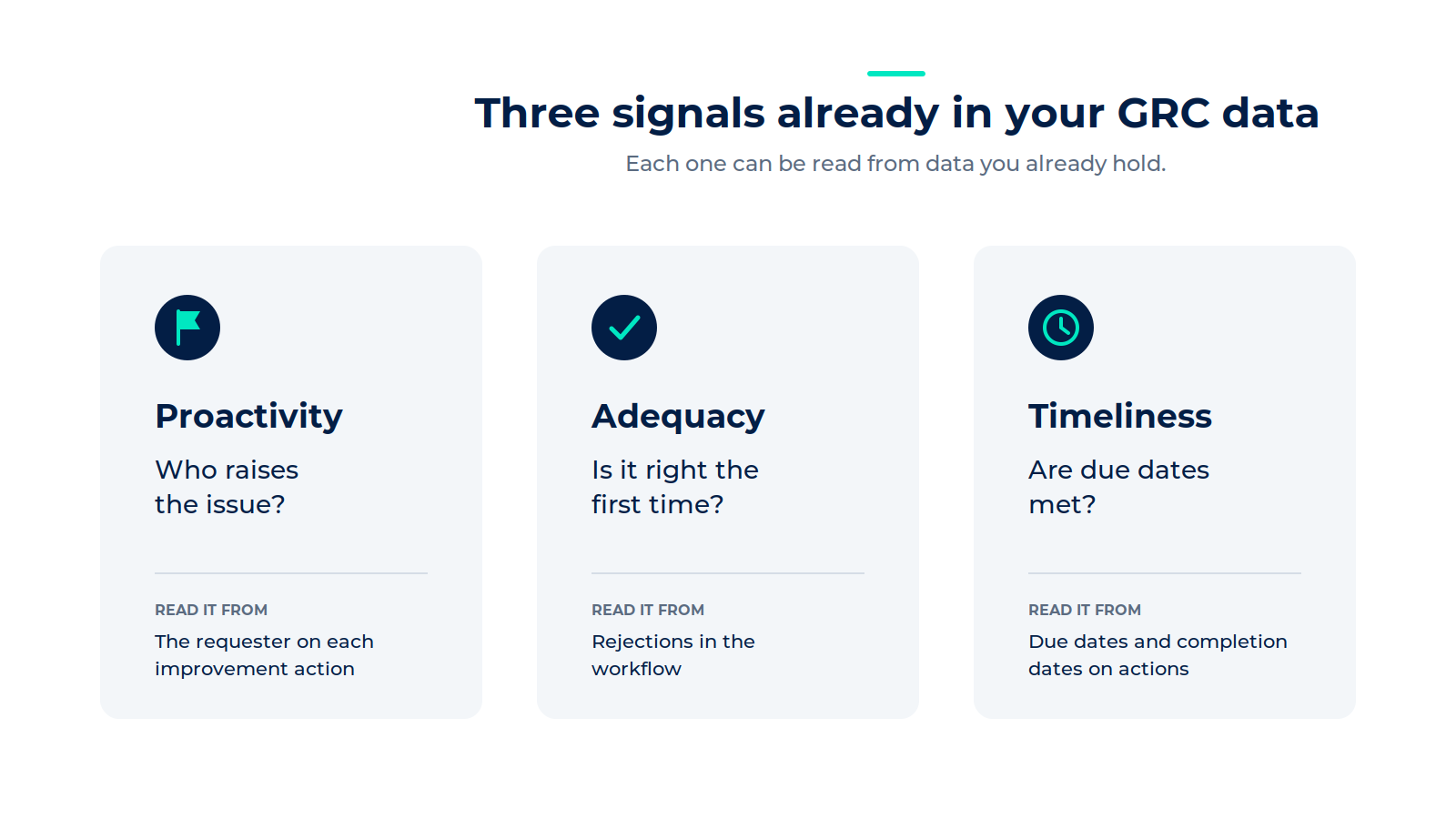
Three signals in your GRC data that show how your organisation handles risk
Takeaways from the CERRIX webinar with Jeroen Tacke and Ruben Andeweg: three signals in your GRC data that show how your organisation handles risk.
.png)
CERRIX vs Diligent: GRC software compared across features, European market fit and compliance
A side-by-side look at two GRC platforms, and which one fits the DORA, NIS2, and ISQM obligations European teams carry.
.png)
Conversational GRC: work with your risk data from the AI agent you already use
Query your controls, update tasks, and generate board-ready reports, all from Claude, Microsoft Copilot or another AI agent.
.jpg)
CERRIX vs ServiceNow: GRC software compared across features, pricing, and compliance
CERRIX vs ServiceNow: GRC Software compared across features, pricing, and compliance (2026)
.jpg)
AI in GRC: beyond the hype. What actually works at every level of adoption
Key takeaways from the CERRIX panel on AI in GRC, with practitioners from CERRIX, AuditAgent and 8weeks.co sharing what actually works.
.avif)
Top European GRC tools in 2026: An insider's comparison
This blog compares the top GRC platforms available to European organizations in 2026

What Does GRC Look Like in 2030?
By 2030, AI in GRC will automate evidence collection, control monitoring, and routine reporting across all three lines of defense, shifting risk managers from administrative work to strategic advisory roles

The Complete GRC Chain: Connecting Regulatory Change Management, Risk, and Controls in One Platform
The future of Governance, Risk & Compliance (GRC) lies in connecting regulatory change management directly to risks, controls, incidents, actions, and assurance activities in one integrated platform.

Embedding automation into your risk operating model: Where AI fits and how to make It work
This second part focuses on what makes that automated model intelligent. Where AI fits. What it means for risk professionals in practice.

From checkbox to continuous: How to embed automation into your risk operating model
What it means to truly embed automation into the risk operating model: what changes, what stays the same, and what it takes to make it work in practice.
.jpg)
Why CERRIX acquired Ruler, and what it means for the future of GRC
CERRIX acquires Ruler to connect regulatory change with risk management.
%20(1).png)
Why Data Quality Is the Foundation of AI and Automation in GRC
A strategic look at why structured data in a GRC tool is imperative for automation, AI enabled workflows, and real time risk insights.
.jpg)
Internal Control Framework Challenges: Why COSO and ISO 31000 Implementations Struggle in Practice
Why do internal control framework implementations (COSO, ISO 31000) struggle? Explore common challenges in process design, ownership, tooling, and governance
%20(3).jpg)
Control Assurance Explained: How Organizations Move from Control Testing to Continuous Monitoring
Discover how modern control assurance moves beyond periodic testing to continuous monitoring, with clear ownership, automation, and expert opinion.

Incident Management under DORA: What Risk and Compliance Leaders Need to Rethink
Incident Management under DORA: What Risk and Compliance Leaders Need to Rethink
.jpg)
Hoe u ISO 31000 Risicobehandeling in de Praktijk Toepast: Inzichten voor Risk- en Complianceleiders
A practical recap of CERRIX ISO 31000 risk treatment webinar
%20(1).jpg)
Hoe Wij CERRIX GRC Gebruiken voor het Beheren van Ons ISMS. ISO 27001 in de Praktijk
Wij gebruiken onze eigen CERRIX GRC-software om het ISMS van CERRIX te beheren. Zo maken we van compliance een continu proces en laten we zien hoe ISO 27001 onderdeel wordt van de dagelijkse praktijk.
%20(1).jpg)
Hoe bereken je risicokans en -impact?
Leer hoe je risicokans en -impact berekent volgens ISO 31000. Ontdek hoe gestructureerde risicobeoordeling, scoringsmodellen en risicomatrices bijdragen aan effectief risicomanagement met CERRIX.
.jpg)
Why the Three Lines of Defense Model Is Outdated? What Every Board Should Know About the Three Lines Model
Three Lines Model Explained: Why Boards Must Move Beyond 3LOD
.jpg)
What Is ISO 31000 and How Does It Work?
Discover what ISO 31000 is, how it works, and why it’s essential for risk management in 2025. Learn the principles, framework, and how tools like CERRIX help organizations turn ISO 31000 into practice.
.jpg)
How to Write an Incident Report That Stands Up to Audits
Learn how to write incident reports that are clear, evidence-backed, and audit-ready. Includes a template, best practices, and compliance alignment for risk professionals.
.jpg)
How to Implement ISO 31000: Real-Time Risk Decisions with AI‑Enabled Tools
Discover how to move beyond compliance and operationalize ISO 31000 using AI, real-time dashboards, and structured risk assessments. Learn from webinar insights and best practices tailored for financial services and regulated industries.
%20(1).jpg)
What’s Blocking Your ISMS Rollout? 7 Fixable Challenges for Financial Institutions
Discover the 7 biggest blockers in ISMS rollout for financial institutions—and how to solve them. Learn practical strategies to secure buy-in, define scope, streamline controls, and prepare for ISO 27001 certification.
.jpg)
Trends Driving ISMS Adoption in 2025: What Risk & Compliance Leaders Need to Know
Discover the top trends pushing organizations toward ISMS adoption in 2025—from regulatory changes and remote work to threat evolution and AI. Learn what to prioritize to stay ahead in risk and compliance.
What Is an ISMS? A Practical Guide for Risk & Compliance Leaders in 2025
An Information Security Management System (ISMS) is more than policy—it’s your organization’s shield against evolving threats, regulation, and reputation risk. Discover what ISMS means, how to implement it, and why it matters in 2025.
.jpg)
The Intelligent Future of GRC: How AI is Reshaping Governance, Risk & Compliance in 2025
Explore how AI is transforming GRC in 2025—from predictive insights and automation to ethical oversight. Learn what features matter, what risks to manage.
.jpg)
How Do You Implement an ISMS in Financial Services Without Slowing Down Innovation?
Implementing an ISMS in financial services? Explore a practical, risk-aligned roadmap tailored for banks, fintechs, and insurers to meet ISO 27001, GDPR, and DORA compliance—without compromising agility.

How Do You Build a Robust ISMS Framework Based on ISO 27001?
Learn how to build a robust ISMS framework aligned with ISO 27001. Discover the key components—people, policies, processes, and controls—to strengthen security and achieve compliance.
.jpg)
When to Conduct Risk Assessments: 6 Enterprise-Critical Moments
Learn when to conduct risk assessments—annual, quarterly, after incidents or change—and how CERRIX ensures continuous compliance.
.jpg)
How do you build a system of quality management that works under ISQM 1?
Learn how to build a system of quality management under ISQM 1. Move beyond compliance to an operational model that proves audit quality.

What Are Risk Scoring Methods for Financial Institutions? [2025 Guide]

From Risk Assessment to Risk Management: Moving Beyond Checklists in 2025
Understand the evolution from risk assessment to strategic risk management in 2025. Learn why leading organizations are embedding risk into decision-making—and how GRC platforms like CERRIX support this shift.

What is risk management? A strategic guide for leaders in 2025

How Audit Firms Embed ISQM into Daily Practice
In our second ISQM webinar, experts from RSM, Grant Thornton, and CERRIX shared practical insights on how audit firms can embed ISQM into the heart of their operations.

Embedding ISQM 1 into the DNA of Your Audit Firm: A Risk-Based Approach to Quality Management
Discover how to implement ISQM 1 with a risk-based approach. Learn how audit firms can embed quality management into daily operations and governance.
%20(1).avif)
CERRIX User Conference 2025
Op 12 maart 2025 kwamen marktleiders, verzekeringsexperts en CERRIX-klanten samen voor de CERRIX User Conference 2025, een dag van kennisuitwisseling, inzichtelijke discussies en samenwerking over de toekomst van risicobeheer, compliance en AI-gestuurde GRC-oplossingen.

Van spreadsheets tot GRC-software: waarom pensioenfondsen een moderne benadering van risicobeheer nodig hebben

CERRIX en BR1GHT versterken langdurige samenwerking om oplossingen voor bestuur, risico, compliance en audit te verbeteren

DORA implementeren: van compliance tot veerkracht op lange termijn
