Selecting a GRC platform is one of the more consequential technology decisions a risk or compliance team makes. The platform shapes how risks are identified, how controls are tested, how audit findings are tracked, and how regulatory obligations are demonstrated to supervisors. Get it right and it becomes infrastructure. Get it wrong and it becomes a project that consumes resources without delivering the oversight it promised.
CERRIX and Diligent both appear on shortlists for European organisations. On the surface they look similar: both cover risk, compliance, and audit in one environment, and both serve regulated industries. But they were built for different buyers, in different regulatory contexts, with different assumptions about what a GRC implementation looks like in practice.
This comparison looks at both platforms across the dimensions that tend to decide the choice: features, implementation, European regulatory fit, pricing, and total cost of ownership.
A quick overview of both platforms
CERRIX is a European GRC platform, founded in 2014 in the Netherlands and headquartered in The Hague, with a second office in Belgium. It is built for regulated organisations: financial institutions, insurers, pension funds, asset managers, audit firms, and mid-to-large enterprises under European supervision. The platform connects risk and control management, compliance, incident and third-party management, process control, GDPR, and audit in one system. Following the acquisition of Ruler, CERRIX adds AI-powered regulatory monitoring, so the chain from a regulatory change to the affected controls runs in one place. CERRIX is ISO/IEC 27001 certified, ISAE 3402 Type II verified, and FSQS-NL registered. More than 100 financial institutions in over 20 countries use CERRIX.
Diligent was founded in 1994 in New York City. Its first widely used product was a board portal, Diligent Boards, which moved board communications from paper to digital. The company has since expanded through acquisitions, including Galvanize (ACL) in 2021, into the Diligent One Platform. That platform combines board management with risk, audit, compliance, ESG reporting, and third-party risk. Diligent reports more than 25,000 organisations across 130 countries, with its customer base weighted toward large listed companies.
The differences become clearer when you move from category labels to the operational reality of implementation, adoption, and regulatory fit. CERRIX is a European GRC platform built around the frameworks that European supervisors enforce. Diligent One is a broad governance platform whose risk and compliance modules sit on a board-governance foundation. That difference runs through most of what follows.
A straightforward comparison
Features comparison
Risk management
CERRIX handles risk management in one connected environment. Risk registers, control frameworks, key risk indicators, and incidents live together, built around the Three Lines model. The board sees the same data too: CERRIX includes real-time dashboards and reporting, so leadership gets a live risk view instead of a quarterly report. The point is that CERRIX serves both ends from one source of truth, the board view and the daily work of the first- and second-line owners who log evidence and test controls.
Diligent's platform now spans enterprise risk broadly, though its centre of gravity remains board-level visibility and reporting to executives and directors, in line with its board-governance origins.
The difference is who the platform is organised around. Diligent is oriented upward, to the board and audit committee. CERRIX is organised around the people running risk day to day, and reports upward from the same data.
Compliance management
CERRIX's compliance management is built around the European regulatory environment. DORA, NIS2, GDPR, ISQM, the EU AI Act, MiCA, ICFR, ISO 27001, and DNB and AFM frameworks are available out of the box, so European teams spend less time configuring and interpreting. Test once, comply to many: one control maps to multiple frameworks. With Ruler, CERRIX adds automated regulatory watch and AI-powered impact assessment, connecting a regulatory signal to the control that needs to change.
Diligent connects risk, compliance, and audit on one platform, and markets a single source of truth across those teams, so the difference is not integration. It is two other things. First, European frameworks are configurable content on a global architecture rather than pre-built European supervisory frameworks with ready-made evidence chains, so they take configuration and maintenance as technical standards evolve. Second, the source of regulatory change. Diligent monitors regulatory change across multiple jurisdictions, drawing on a regulatory library provided through a partnership with Regology. Ruler takes a European focus: it monitors sources such as DNB, AFM, ESMA, and EIOPA, and CERRIX connects each change to the obligations and controls it affects.
The difference is who keeps the frameworks current, and from which sources. With Diligent, European frameworks are configured and maintained on a global architecture. With CERRIX, they arrive pre-built, and Ruler tracks the European supervisors your team answers to.
Internal audit
CERRIX provides internal audit as an integrated module that shares the same data as risk and compliance. An audit finding links back to the control it tests and forward to remediation, and follow-up actions are tracked as measures of improvement through to closure, so an audit moves from finding to resolution in one place. The Three Lines model stays visible throughout.
Diligent offers a board-integrated audit view. For organisations where internal audit reports directly to the board and audit committee, that reporting line is where its audit module is oriented.
Third-party risk management
Both platforms cover third-party risk. CERRIX handles outsourcing and ICT third-party risk with the European supervisory context in mind, the areas explicitly regulated under DORA and the EBA outsourcing guidelines. Assessments, contracts, and ongoing monitoring are linked to the risks and obligations they relate to, so third-party risk is part of the same chain rather than a separate silo. Diligent provides vendor lifecycle management, due-diligence workflows, and risk scoring, with third-party summaries presented to board-level stakeholders.
Regulatory watch and AI
Following the Ruler acquisition, CERRIX covers the full GRC chain. Ruler monitors regulatory change from sources such as DNB, AFM, ESMA, and EIOPA and assesses relevance and gaps, and CERRIX maps the impact to risks and controls, assigns ownership, and keeps the audit trail. Ruler is used by more than 150 financial institutions.
Beyond regulatory watch, CERRIX uses AI where it saves the team time, with human-in-the-loop validation: drafting risk descriptions, extracting risks and controls from documents, and generating samples for automated control testing. The result is a continuous loop from regulatory signal to control response, without exporting to a spreadsheet or switching tools.
CERRIX also offers an LLM integration for conversational GRC, so teams can work with their risk and compliance data from an AI agent they already use, such as Claude or Microsoft Copilot. From the chat they can query the control register, take actions like linking evidence to a task and closing it, and turn control-testing results into a board-ready report. It runs on CERRIX APIs and respects existing permissions, so users only see and change what they are allowed to.
Diligent has also added AI to its platform. In 2026 it introduced an AI assistant for directors, followed by agents for risk and audit workflows and AI reporting that turns risk and control data into board-ready reports.
The difference is less about whether AI is there, and more about where it works. Diligent's agents work inside Diligent One. CERRIX works inside the platform and from the AI agent your team already uses, such as Claude or Microsoft Copilot.
European regulatory fit
This is where the choice becomes clearest for most European buyers.
CERRIX is built around the frameworks European financial services firms, insurers, pension funds, and audit organisations are subject to. DORA, NIS2, GDPR, ISQM, MiCA, and the EU AI Act are built into the platform, not added as a configuration project. When technical standards or supervisory guidance shift, CERRIX reflects that in the product. Data is hosted on Microsoft Azure and stays in the EU.
The customer base reflects this. Stater and Blauwtrust Groep in mortgage servicing, VGZ and Menzis in health insurance, and Haier Europe did not choose CERRIX for board-portal functionality. They chose it because it fits the supervisory and audit expectations they face every day.
Diligent's design centre is board governance and listed-company compliance, with European regulatory content available inside a broader global framework. Where board management is the lead requirement, that architecture fits. Where DORA readiness, DNB reporting, or ISQM compliance are the operational priorities, getting there takes meaningful configuration.
Implementation and time to value
CERRIX runs on a predictable timeframe, typically 3 to 6 months: kick-off and requirements, configuration sessions and setup training, implementation and acceptance testing, then go-live and support. The methodology includes knowledge transfer and co-creation with your team, and it is designed so you do not need a dedicated internal IT function to manage the rollout.
Diligent's timeline varies with scope. A single module can go quickly. Full Diligent One rollouts across board, risk, audit, compliance, and ESG take longer, especially where data migration from legacy systems or custom integrations are involved. Users outside IT and technical audit report a steep learning curve, and the breadth of the platform lengthens onboarding for less experienced teams.
For organisations working toward a DORA deadline or preparing for a DNB or AFM inspection, time to value is not a secondary concern. It is the requirement.
Pricing and total cost of ownership
CERRIX uses transparent, euro-denominated pricing built around three packages, Starter, Professional, and Enterprise, each a fixed annual fee that scales with team size and the modules included. Implementation and professional services follow a fixed-price, fixed-scope approach, so total cost of ownership is easier to forecast because implementation effort and ongoing administration are contained.
Diligent does not publish standard list pricing. The platform is modular: organisations typically start with board governance, then add risk, compliance, audit, and ESG over time, with onboarding and professional services quoted separately. Cost accumulates as licences, modules, and implementation grow, which makes the total harder to forecast up front than a fixed-scope approach.
Who uses each platform
CERRIX is used by European financial institutions, insurers, pension funds, asset managers, audit organisations, and mid-to-large enterprises. References span banks (BNG Bank, NIBC), pension (PGGM), insurers (a.s.r., VGZ, Menzis), crypto and MiCA-regulated platforms (Bitvavo) and mortgage servicing (Stater, Blauwtrust Groep). These are organisations managing real regulatory obligations in a European context, from the mid-market to large financial institutions.
Diligent, by its own reporting, serves more than 25,000 organisations across 130 countries, weighted toward listed companies and large enterprises. For a publicly listed multinational with an active board-governance programme and a dedicated GRC function, that is a natural fit. For a Dutch bank or a Belgian insurer whose day-to-day work is DORA, ISQM, and DNB obligations, much of that board-governance architecture is overhead.
Common questions when comparing CERRIX and Diligent
Is Diligent available in Europe? Yes. Diligent operates in around 130 countries and has European customers. The platform supports DORA and NIS2, but as configurable content rather than out-of-the-box European supervisory frameworks. Its architecture was designed around board governance and listed-company compliance.
Is CERRIX a Diligent alternative for mid-to-large-sized European organisations? Yes. CERRIX gives you the depth of an enterprise GRC platform without a board-governance-first architecture, and it is built for the DORA, NIS2, and ISQM obligations European teams carry.
Does CERRIX cover regulatory monitoring? Yes. With Ruler, CERRIX offers regulatory watch and AI-powered impact assessment across the chain from regulatory signal to control response. Diligent also monitors regulatory change across jurisdictions. The difference is focus: Ruler monitors European supervisory sources such as DNB, AFM, ESMA, and EIOPA, and links each change to the obligations and controls in CERRIX.
Which platform is better for DORA compliance? CERRIX is built for DORA and includes pre-configured frameworks, controls, and documentation support. Diligent One can be configured for DORA, which typically involves setup and professional-services effort. For a near-term DORA deadline, CERRIX offers a faster path.
The bottom line
CERRIX is built for the reality of European GRC: a predictable implementation, fixed-scope pricing, out-of-the-box alignment with the frameworks European supervisors enforce, and a partner model focused on adoption from day one. If your organisation operates in Europe, answers to DNB, AFM, or a similar supervisor, and needs a platform your team can use within a reasonable timeframe and budget, CERRIX is worth a close look.
Diligent is a mature platform. For a listed organisation with an active board-governance programme, a large audit committee, and ESG reporting alongside enterprise risk, it has a clear place.
For European financial institutions, insurers, and audit organisations, though, Diligent's architecture reflects board-governance priorities that do not map cleanly to the supervisory work they do every day. A platform built around board portals and listed-company governance is not the same as one built for daily risk management and regulatory compliance under DORA, ISQM, and DNB supervision.
Want to see how CERRIX compares to other platforms? Read our overview of the Top European GRC tools in 2026.
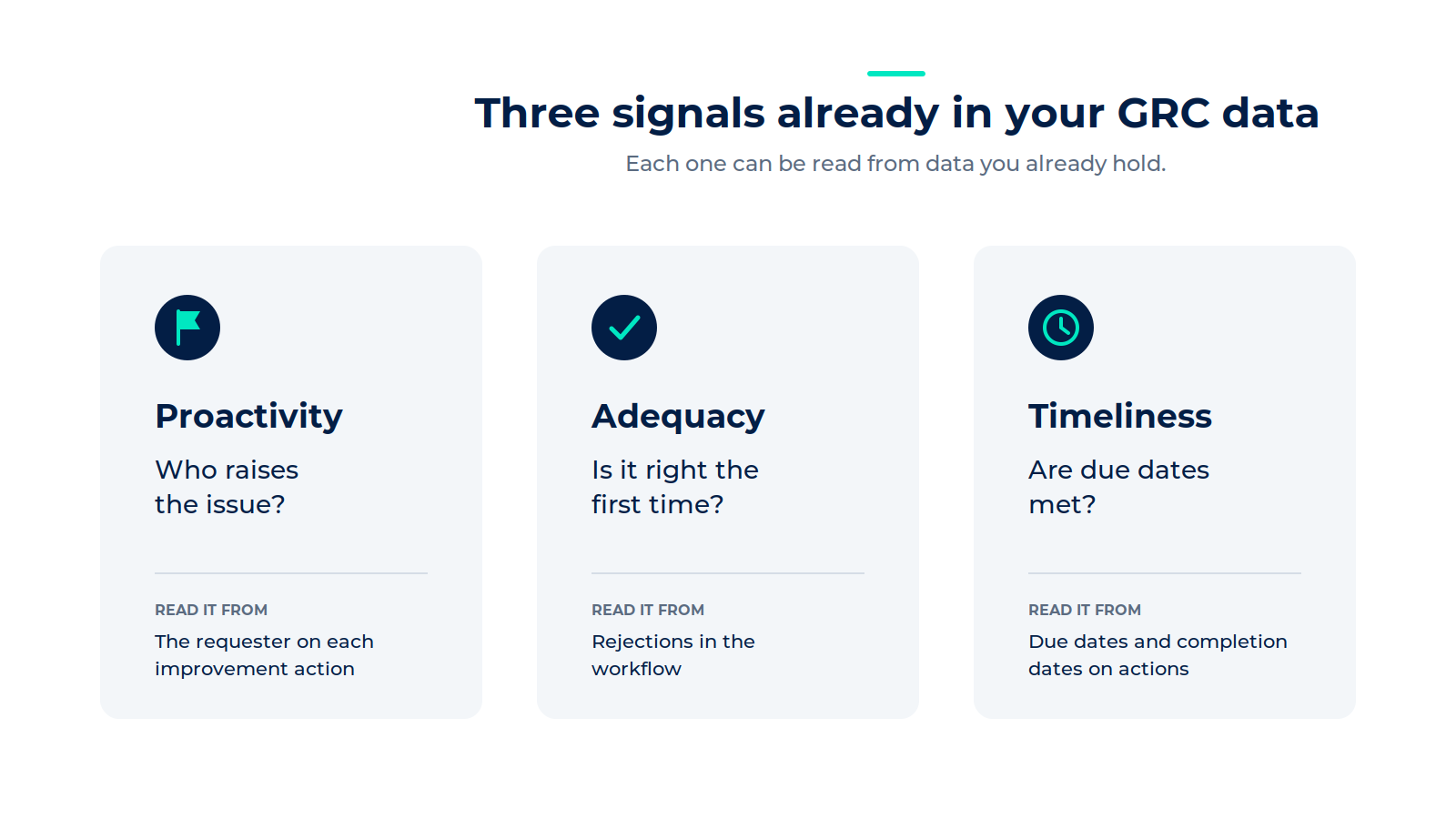
Three signals in your GRC data that show how your organisation handles risk
Takeaways from the CERRIX webinar with Jeroen Tacke and Ruben Andeweg: three signals in your GRC data that show how your organisation handles risk.
.png)
CERRIX vs Diligent: GRC software compared across features, European market fit and compliance
A side-by-side look at two GRC platforms, and which one fits the DORA, NIS2, and ISQM obligations European teams carry.
.png)
Conversational GRC: work with your risk data from the AI agent you already use
Query your controls, update tasks, and generate board-ready reports, all from Claude, Microsoft Copilot or another AI agent.
.jpg)
CERRIX vs ServiceNow: GRC software compared across features, pricing, and compliance
CERRIX vs ServiceNow: GRC Software compared across features, pricing, and compliance (2026)
.jpg)
AI in GRC: beyond the hype. What actually works at every level of adoption
Key takeaways from the CERRIX panel on AI in GRC, with practitioners from CERRIX, AuditAgent and 8weeks.co sharing what actually works.
.avif)
Top European GRC tools in 2026: An insider's comparison
This blog compares the top GRC platforms available to European organizations in 2026

What Does GRC Look Like in 2030?
By 2030, AI in GRC will automate evidence collection, control monitoring, and routine reporting across all three lines of defense, shifting risk managers from administrative work to strategic advisory roles

The Complete GRC Chain: Connecting Regulatory Change Management, Risk, and Controls in One Platform
The future of Governance, Risk & Compliance (GRC) lies in connecting regulatory change management directly to risks, controls, incidents, actions, and assurance activities in one integrated platform.

Embedding automation into your risk operating model: Where AI fits and how to make It work
This second part focuses on what makes that automated model intelligent. Where AI fits. What it means for risk professionals in practice.

From checkbox to continuous: How to embed automation into your risk operating model
What it means to truly embed automation into the risk operating model: what changes, what stays the same, and what it takes to make it work in practice.
.jpg)
Why CERRIX acquired Ruler, and what it means for the future of GRC
CERRIX acquires Ruler to connect regulatory change with risk management.
%20(1).png)
Why Data Quality Is the Foundation of AI and Automation in GRC
A strategic look at why structured data in a GRC tool is imperative for automation, AI enabled workflows, and real time risk insights.
.jpg)
Internal Control Framework Challenges: Why COSO and ISO 31000 Implementations Struggle in Practice
Why do internal control framework implementations (COSO, ISO 31000) struggle? Explore common challenges in process design, ownership, tooling, and governance
%20(3).jpg)
Control Assurance Explained: How Organizations Move from Control Testing to Continuous Monitoring
Discover how modern control assurance moves beyond periodic testing to continuous monitoring, with clear ownership, automation, and expert opinion.

Incident Management under DORA: What Risk and Compliance Leaders Need to Rethink
Incident Management under DORA: What Risk and Compliance Leaders Need to Rethink
.jpg)
Hoe u ISO 31000 Risicobehandeling in de Praktijk Toepast: Inzichten voor Risk- en Complianceleiders
A practical recap of CERRIX ISO 31000 risk treatment webinar
%20(1).jpg)
Hoe Wij CERRIX GRC Gebruiken voor het Beheren van Ons ISMS. ISO 27001 in de Praktijk
Wij gebruiken onze eigen CERRIX GRC-software om het ISMS van CERRIX te beheren. Zo maken we van compliance een continu proces en laten we zien hoe ISO 27001 onderdeel wordt van de dagelijkse praktijk.
%20(1).jpg)
Hoe bereken je risicokans en -impact?
Leer hoe je risicokans en -impact berekent volgens ISO 31000. Ontdek hoe gestructureerde risicobeoordeling, scoringsmodellen en risicomatrices bijdragen aan effectief risicomanagement met CERRIX.
.jpg)
Why the Three Lines of Defense Model Is Outdated? What Every Board Should Know About the Three Lines Model
Three Lines Model Explained: Why Boards Must Move Beyond 3LOD
.jpg)
What Is ISO 31000 and How Does It Work?
Discover what ISO 31000 is, how it works, and why it’s essential for risk management in 2025. Learn the principles, framework, and how tools like CERRIX help organizations turn ISO 31000 into practice.
.jpg)
How to Write an Incident Report That Stands Up to Audits
Learn how to write incident reports that are clear, evidence-backed, and audit-ready. Includes a template, best practices, and compliance alignment for risk professionals.
.jpg)
How to Implement ISO 31000: Real-Time Risk Decisions with AI‑Enabled Tools
Discover how to move beyond compliance and operationalize ISO 31000 using AI, real-time dashboards, and structured risk assessments. Learn from webinar insights and best practices tailored for financial services and regulated industries.
%20(1).jpg)
What’s Blocking Your ISMS Rollout? 7 Fixable Challenges for Financial Institutions
Discover the 7 biggest blockers in ISMS rollout for financial institutions—and how to solve them. Learn practical strategies to secure buy-in, define scope, streamline controls, and prepare for ISO 27001 certification.
.jpg)
Trends Driving ISMS Adoption in 2025: What Risk & Compliance Leaders Need to Know
Discover the top trends pushing organizations toward ISMS adoption in 2025—from regulatory changes and remote work to threat evolution and AI. Learn what to prioritize to stay ahead in risk and compliance.
What Is an ISMS? A Practical Guide for Risk & Compliance Leaders in 2025
An Information Security Management System (ISMS) is more than policy—it’s your organization’s shield against evolving threats, regulation, and reputation risk. Discover what ISMS means, how to implement it, and why it matters in 2025.
.jpg)
The Intelligent Future of GRC: How AI is Reshaping Governance, Risk & Compliance in 2025
Explore how AI is transforming GRC in 2025—from predictive insights and automation to ethical oversight. Learn what features matter, what risks to manage.
.jpg)
How Do You Implement an ISMS in Financial Services Without Slowing Down Innovation?
Implementing an ISMS in financial services? Explore a practical, risk-aligned roadmap tailored for banks, fintechs, and insurers to meet ISO 27001, GDPR, and DORA compliance—without compromising agility.

How Do You Build a Robust ISMS Framework Based on ISO 27001?
Learn how to build a robust ISMS framework aligned with ISO 27001. Discover the key components—people, policies, processes, and controls—to strengthen security and achieve compliance.
.jpg)
When to Conduct Risk Assessments: 6 Enterprise-Critical Moments
Learn when to conduct risk assessments—annual, quarterly, after incidents or change—and how CERRIX ensures continuous compliance.
.jpg)
How do you build a system of quality management that works under ISQM 1?
Learn how to build a system of quality management under ISQM 1. Move beyond compliance to an operational model that proves audit quality.

What Are Risk Scoring Methods for Financial Institutions? [2025 Guide]

From Risk Assessment to Risk Management: Moving Beyond Checklists in 2025
Understand the evolution from risk assessment to strategic risk management in 2025. Learn why leading organizations are embedding risk into decision-making—and how GRC platforms like CERRIX support this shift.

What is risk management? A strategic guide for leaders in 2025

How Audit Firms Embed ISQM into Daily Practice
In our second ISQM webinar, experts from RSM, Grant Thornton, and CERRIX shared practical insights on how audit firms can embed ISQM into the heart of their operations.

Embedding ISQM 1 into the DNA of Your Audit Firm: A Risk-Based Approach to Quality Management
Discover how to implement ISQM 1 with a risk-based approach. Learn how audit firms can embed quality management into daily operations and governance.
%20(1).avif)
CERRIX User Conference 2025
Op 12 maart 2025 kwamen marktleiders, verzekeringsexperts en CERRIX-klanten samen voor de CERRIX User Conference 2025, een dag van kennisuitwisseling, inzichtelijke discussies en samenwerking over de toekomst van risicobeheer, compliance en AI-gestuurde GRC-oplossingen.

Van spreadsheets tot GRC-software: waarom pensioenfondsen een moderne benadering van risicobeheer nodig hebben

CERRIX en BR1GHT versterken langdurige samenwerking om oplossingen voor bestuur, risico, compliance en audit te verbeteren

DORA implementeren: van compliance tot veerkracht op lange termijn
